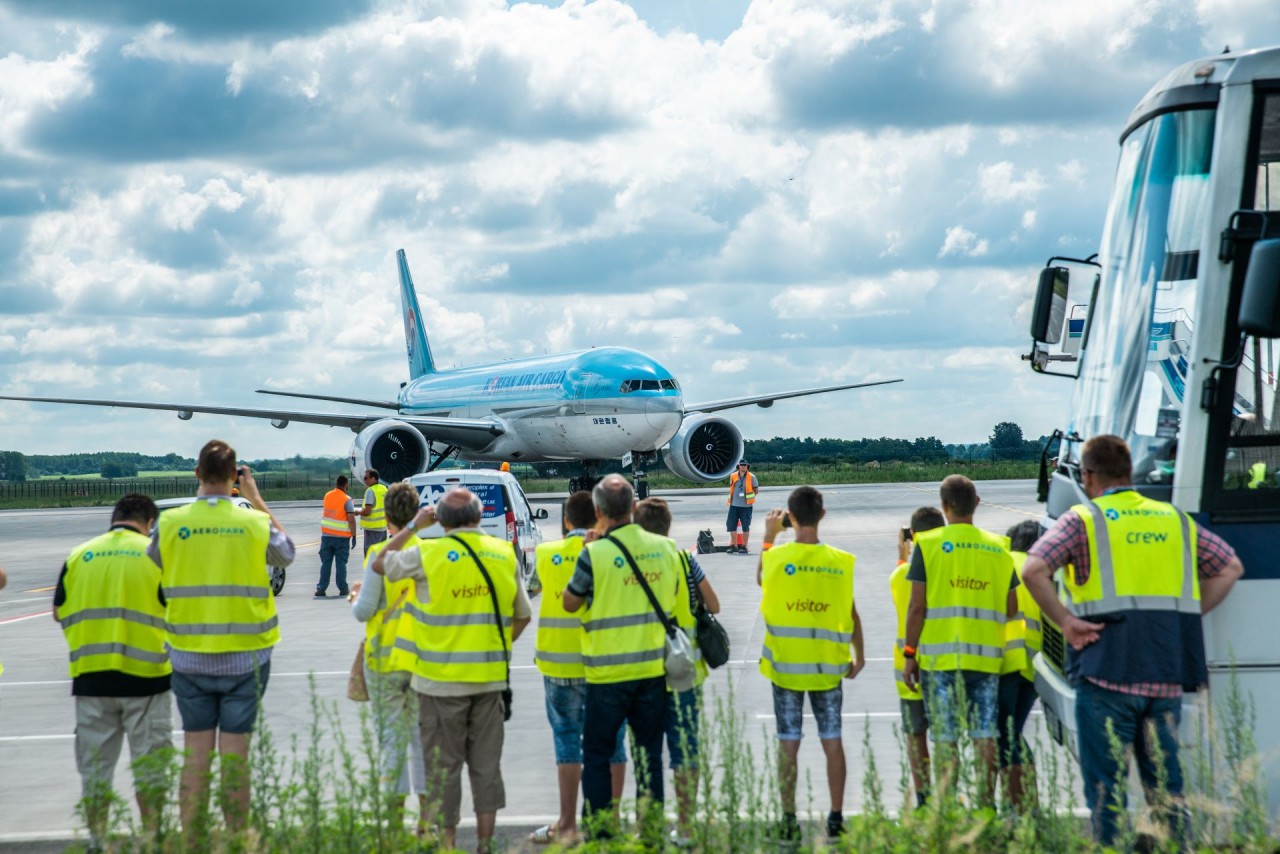
Retro, thrills, spectacle. Giant aircraft up close. The airport like you never see it as a passenger. Dates for guaranteed tours are now available. Pick a time and join us by day or at night to explore this extraordinary little city. Don’t miss out. Come behind the curtain at Budapest Ferenc Liszt International Airport (Budapest Liszt Ferenc Nemzetközi Repülőtér) and get close to the mysterious world of aviation.
Airport tours and hangar walks run by day and by night. We’ll take you behind the scenes at Ferenc Liszt International, where the choreography keeps aircraft turning around to the minute and entire systems hum out of sight of the terminals.
A Little City Behind the Curtain
Ferenc Liszt Airport is a self-sufficient small town within the metropolis, with its own wells and waterworks, a treatment plant, even a thermal power station. From the moment a plane touches down, a small army swings into action on a second-perfect timetable so it can take off again about 30 minutes later. And most air traffic control doesn’t even happen in the tower—or on the airport grounds.
If you’ve never stood by the runway lights, seen the radar installations, looked up at the control tower, or rolled past the fire station, hop on the bus and come with us to explore Budapest Ferenc Liszt International Airport up close.
Where Even the Concrete Glows
This is the surface that swallows the landings of aircraft weighing hundreds of tons. Budapest (Ferihegy) runs two “bayonet” configuration runways for arrivals and departures: one is 3,009 meters long (9,869 feet), the other 3,707 meters (12,166 feet).
What Is a Runway?
The runway—also called the takeoff and landing strip—is a long, wide, straight concrete or asphalt surface where planes accelerate to reach the speed needed for lift, and where they decelerate after touchdown to exit safely. Orientation is set by prevailing winds and obstacles; length, width, load-bearing, and instrumentation match the airport’s role and its typical aircraft. Aviation parlance skips “kifutópálya”—that’s for catwalks and zoos.
Apron Life and Taxiways
Aircraft park on aprons. On the traffic aprons, jets “turn” between flights: passengers off and on, refueling, loading, unloading. The cargo apron mirrors this for freight. On the maintenance aprons by the hangars, aircraft wait for scheduled checks or for sign-off to return to service. Runways and aprons are linked by taxiways—narrower than runways and laid out as a maze to move aircraft efficiently.
How Pilots Navigate on the Ground
Runways, taxiways, and aprons sit on a unified, 27.6-inch-thick load-bearing structure. Markings, lighting, and guidance signs flank every surface to keep traffic flowing, especially in low visibility. Budapest runs some 5,500 navigational light sources, many now LED for efficiency and longevity, and both runways are fully equipped with world-class ILS (Instrument Landing System) from both ends.
Why 13R and 31L?
The “1” and “2” labels only reflect construction order. The navigational name comes from the magnetic heading with the last digit dropped, plus letters for Left/Right on parallel runways. Approach from Monor and the second runway reads 31R; from Rákoshegy it’s 13L. These alphanumerics are painted in huge distorted lettering to match the 3-degree glide path, following threshold “zebra” striping. Markings on taxiways and aprons are complex but standardized, guiding inch-accurate maneuvers into jet-bridge stands. You’ll even spot the familiar octagonal red STOP—painted on concrete with an aircraft icon—reminding ground drivers to yield to taxiing planes.
Both runways demand constant care: winter snow clearing; routine rubber removal in touchdown zones; sealing expansion joints; maintaining inset and frangible-mounted edge lights. Many fixtures need regular angle calibration by aircraft or specialized ground equipment.
From Pasture to Paved Precision
Like most early airfields, Ferihegy began as an oval meadow. The outline still traces around Runway 1 beneath today’s service road and a hardy hedge of Osage orange that once stood in for fencing. In the 1920s–30s, aircraft were lighter and underpowered, so flying strictly into wind was vital. A red-white windsock—the buló—told crews strength and direction.
Heavier, more capable aircraft pushed the shift to paved surfaces to keep operations independent of soil conditions. Orientation was easy to pick: find the most worn path in the grass—your most common takeoff and landing direction. Prevailing winds at Ferihegy are northwesterly, which set the first runway.
A 1,500-meter runway opened in 1950 with the airport, later extended to 2,500 and then 3,009 meters (9,869 feet). A crosswind strip was once sketched—its stub visible halfway along in vintage aerials—aligned northeast–southwest, but as aircraft improved and handled stronger crosswinds, it was never built.
Why Build a Second Runway
The second runway idea surfaced in the 1970s, less for capacity—London Gatwick shows a single runway can handle 30 million passengers—than for strategy. Ferihegy was Hungary’s only public international airport; if one runway shut, air travel would grind to a halt nationwide.
The design nailed the textbook solution: the same heading as the original, honoring wind while doubling throughput with properly spaced parallels. The new centerline sits 1,600 meters away, enabling independent ops, and shifts southeast into a “Z” bayonet to minimize taxi times. Using one runway for arrivals and the other for departures boosts movements per hour. Arriving from the southeast on heading 310 to 31 Right, jets roll straight into Terminal 2. Departing, they taxi barely at all to line up on Runway 1’s 31 Left threshold.
Runway 2 is 3,707 meters long (12,166 feet) and 45 meters wide, or 60 meters including two 7.5-meter paved shoulders. Its endpoints differ by 23 meters of elevation—well within the 1% slope allowed globally. Low vis? State-of-the-art lighting and ILS keep traffic flowing safely. The “new” runway went live in 1983.
Runway Run: Sneakers on the Strip
Every late summer for the past nine years, Runway 1 swaps landing gear for running shoes. About 1,100 people from across global aviation race for good causes. Entry fees from the Runway Run support Hungary’s SUHANJ! foundation and the UK’s Anthony Nolan charity funding children’s bone marrow transplants.
Take the Tour
The route takes you into areas closed not just to passengers but to most airport staff. See traffic and maintenance aprons, both runways, navigation gear, radar sites, and a stack of once-hidden corners. Sign up, climb aboard, and see Ferihegy’s secrets with us.