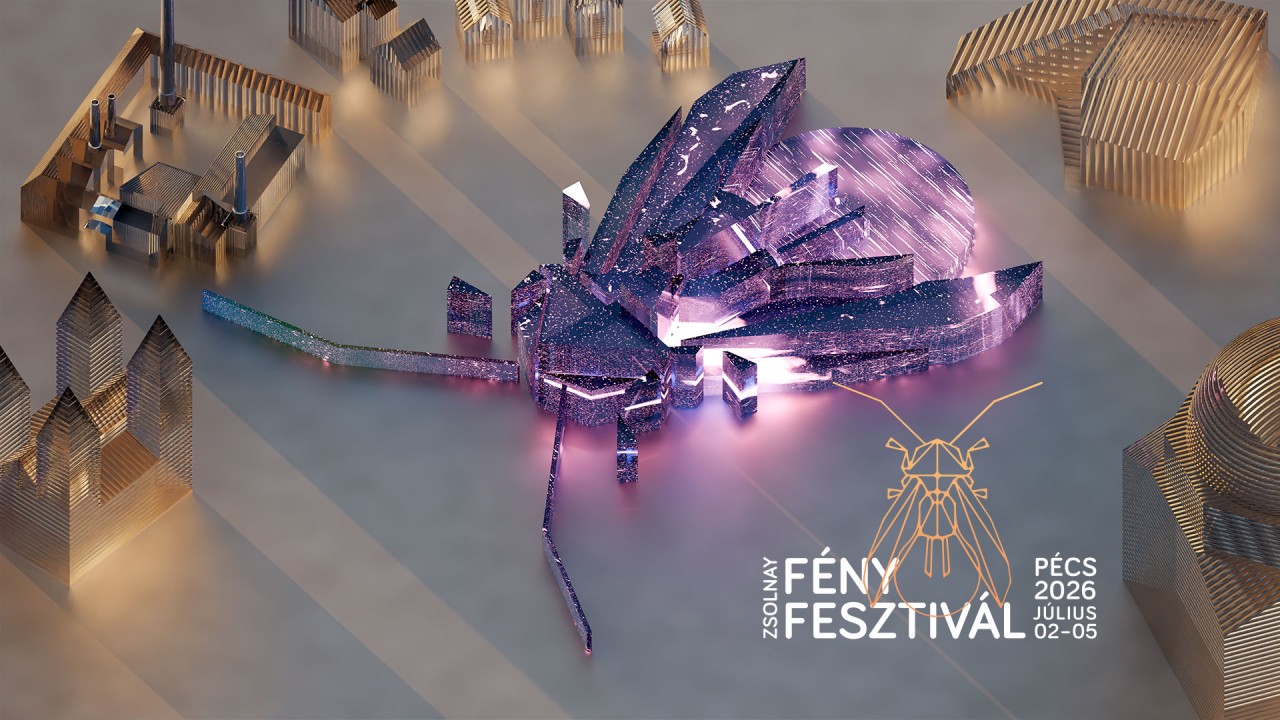
Pécs will glow again this summer as the 10th Zsolnay Light Festival floods the city with art and illumination from July 2 to 5, 2026. What started a decade ago as a bold experiment in contemporary light art has become the highlight of Pécs’s cultural calendar, drawing crowds in the hundreds of thousands. After nightfall, Hungarian and international artists transform façades, courtyards, galleries, and hidden venues that open only for the festival, filling streets and squares with site-specific projections and immersive light pieces.
This year’s anniversary edition promises to be the biggest and most spectacular yet: four nights, more than thirty works, and a unifying theme celebrating Victor Vasarely, the Pécs-born father of Op Art. As part of the Vasarely memorial year, the festival explores his PLASTI-CITÉ // COLORED CITY concept—inviting everyone into a world of optical illusion, motion, space, and light.
With more than 100,000 visitors annually, the Zsolnay Light Festival now ranks among Europe’s most striking urban festivals. The 2026 program dovetails with two major anniversaries: the 120th year since Vasarely’s birth and the 50th anniversary of the Vasarely Museum in Pécs. The whole city becomes an open gallery where light turns architecture into an instrument, and audiences don’t just look—they take part.
The Cathedral Becomes the Biggest Screen
Night after night, the Zsolnay Light Art Video Mapping Competition will convert the façade of Pécs Cathedral into a colossal projection canvas. Italian, Chinese, and Bulgarian teams are in the running, their visuals deeply rooted in Vasarely’s Op Art legacy, with the public deciding the winner. Alongside the competition, the Irish focus program brings a special debut: Kiégő Izzók present a homage projection honoring the life’s work of Ferenc Martyn.
The Path of Light: 30+ Stops at the Edge of Imagination
The festival’s backbone is the Path of Light—15 downtown and 19 Zsolnay Quarter–adjacent locations showcasing works by international and Hungarian light artists. This year, the Zsolnay Quarter and Kodály Center form the main experience hub, reimagined as Fényfesztivál MAX. With a festival wristband, visitors can dive into the most ambitious installations—interactive, immersive pieces designed to fill an entire evening.
At the Kodály Center, Latvia’s Those Guys Lighting present Divine Geometry: a 30-minute, sound-sculpted laser work woven from 24 beams. It’s an essential, almost meditative light experience so intense that past audiences were moved to tears.
In the Zsolnay Quarter’s Labor, Spanish artist Marc Vilanova unveils a walk-through waterfall woven from light. Over in E78, the Playmodes studio builds dynamic, floating light sculptures from laser beams and robotic mirrors. In the Pirogránit Courtyard, a new installation lifts Vasarely’s Op Art heritage into 3D space—geometric illusions that morph with the viewer’s movement and reward exploration.
Inside the m21 Gallery, a milestone exhibition anchors the season: Hommage à Vasarely by Light. For the first time, a show outlives the festival itself, running throughout the summer so visitors can drop in anytime through the end of August for an extended visual journey. The Quarter also hosts the Light Art Residency, where emerging artists debut fresh work.
Downtown Icons, Recast in Light
The Cella Septichora Visitor Center houses a glass cube containing a pulsing light-being—a digital organism straining to break free. Széchenyi Square becomes a monumental 360-degree panorama of light, while Jókai Square welcomes back the festival’s totem creature, the Pixelbogár. Inside Árkád, tech meets nature as a massive LED wall conjures the memory of water in motion.
Back to the ’70s: Psychedelia on Színház Square
Színház Square turns into a time machine courtesy of New York’s Liquid Light Lab, reviving the legendary analog light shows of the 1970s. Think Kandinsky’s colors meeting the energy of Jimi Hendrix and early Pink Floyd—a weightless, sensuous universe that draws crowds in for four nights straight. This Path of Light stop forms part of the USA250 commemorations. Tilos Rádió DJs push the vibe to the max, making it less a screening and more a shared, psychedelic trip into the realm of light.
Vasarely believed art is a common language that should step out of galleries and into everyday life. That principle pulses through the Path of Light, which turns the urban fabric into an open gallery where interactivity makes visitors co-creators and part of a collective experience, says Márk Hummel, managing director of Zsolnay Heritage Management Nonprofit Ltd., which organizes the festival.
More Than Light: Street Theater and Celebration
Beyond projection art, the four-day program spills into the streets with fire jugglers, acrobats, and street theater troupes. Families will find interactive kids’ programs and luminous craft workshops, while concerts and electronic parties keep the city’s heartbeat going deep into the night.
This year’s Irish focus adds extra flavor: in addition to the Ferenc Martyn homage at the Cathedral and a dedicated Irish Path of Light stop, Káptalan Street hosts an Irish gastronomic courtyard. Music and dance from the island nation color the atmosphere throughout.
Downtown public installations and programs are free. Entry to indoor venues, the Zsolnay Quarter, and the special installations at the Kodály Center is available with a Fényfesztivál MAX wristband, on sale from May 7.
Pécs is the shining point of summer. July 2–5, 2026. Pécs.