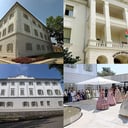
Budapest’s Virág Judit Gallery and Auction House (Virág Judit Galéria és Aukciósház) rolls into mid-May with a two-week showcase of heavyweight exhibitions and auctions spanning classical masters, modernist milestones, and postwar icons. The program runs May 4–16, 10 a.m.–6 p.m. daily, at the gallery’s home base on 30 Falk Miksa Street (Falk Miksa u. 30) in the 5th District, with the 81st Spring Auction set for May 17 at the Budapest Congress Center (Kongresszusi Központ) and the 18th Contemporary Auction landing May 19 at the Budapest Music Center. Bidders can take part in person, by phone, via absentee bids, or through the gallery’s custom online platform.
81st Spring Auction: From Trieste to the Paris avant-garde
The headline lot for the Spring Auction is a radiant 1927 canvas by János Vaszary, painted in Trieste during a coastal tour of the northern Adriatic that also took him to Portorož and Piran. While Portorož’s buzzing beach life drew his eye there, it was the maritime world of Piran and Trieste that fired his imagination. In this Trieste scene, the vast piazza opening onto the harbor—the Piazza dell’Unità—unfurls under fierce Mediterranean light. Vaszary distills the essence of the view: reduced means, simplified light and space, amped-up color. Under a bright parasol at a café terrace, elegant women in cloche hats chat with a soldier while two gendarmes quietly preside over the calm, the whole picture smoldering with decorative warmth.
Another prize is Imre Szobotka’s 1915 painting Műteremben (In the Studio), a keystone of Hungarian Cubism. Fresh from finishing the Budapest School of Applied Arts in 1910, Szobotka decamped to Paris and the La Palette academy, studying under Jean Metzinger and Henri Le Fauconnier—central figures of emergent Cubism. He vaulted into the thick of Europe’s avant-garde: artists he revered in the 1911 Salon des Indépendants’ Cubist room would be peers beside him just two years later. Szobotka etched his name into art history as one of the key exponents of the modernist Cubist current after the turn of the century.
The Spring Auction adds more firepower: Vilmos Aba-Novák’s circus-world tableau capturing the 1930s mood; Károly Patkó’s Subiaco, painted in Italy; and Ödön Márffy’s garden scene with effortless French poise. Portrait lovers will find sleek Art Deco elegance in women’s portraits by Béla Kádár and Hugó Scheiber.
Exhibition and sale details
The auction preview for the 81st Spring Auction runs May 4–16, daily 10 a.m.–6 p.m., at Virág Judit Gallery (Virág Judit Galéria), 1055 Budapest, 30 Falk Miksa Street. The auction takes place Sunday, May 17, 6 p.m., at the Budapest Congress Center (Kongresszusi Központ). The gallery welcomes visitors to both the preview and the sale.
18th Contemporary Auction: Postwar giants and market records
The May 19 sale at the Budapest Music Center centers on postwar and contemporary works, headlined by Simon Hantaï alongside Ilona Keserü, Dóra Maurer, Imre Bak, Ákos Birkás, Pál Deim, and János Fajó. Hantaï—who spent nearly his entire active career in France and rose to become one of the world’s most celebrated abstract painters—dominates the lineup with a major oil from 1955, titled simply “Festmény” (Painting). Works by Hantaï are rarities in the Hungarian market, especially at this scale and quality. The piece hits the block with an opening bid of 50,000,000 HUF (about 135,000 USD), and an estimate between 95,000,000 and 120,000,000 HUF (about 257,000–325,000 USD). For context, a Hantaï work fetched 1,400,000,000 HUF (around 3,780,000 USD) in 2016, a record for a Hungarian or Hungarian-born artist.
Imre Bak’s 1995 work Die Stadt (The City) enters the arena with a starting price of 11,000,000 HUF (about 29,700 USD). Ákos Birkás’s emblematic Kopf (Head) from 1996, part of his signature Head series, also goes under the hammer. Pál Deim’s Csend (Silence), dated 1990 and long anticipated by collectors, opens at 8,500,000 HUF (about 22,900 USD). Ilona Keserü—holder of the highest price for a living Hungarian artist, with a record of 110,000,000 HUF (about 297,000 USD)—is represented by Anguillara, painted in 1963 during a pivotal scholarship year in Rome, starting at 10,000,000 HUF (about 27,000 USD).
Beyond these marquee names, the sale fields works by János Fajó, Dóra Maurer, István Nádler, and ef. Zámbó István, cementing a tight snapshot of Hungarian postwar and contemporary abstraction’s global-facing momentum.
How to visit and bid
Both auction previews run May 4–16, 10 a.m.–6 p.m., at Virág Judit Gallery (Virág Judit Galéria), 1055 Budapest, 5th District, 30 Falk Miksa Street. The 81st Spring Auction takes place Sunday, May 17, 6 p.m., at the Budapest Congress Center (Kongresszusi Központ). The 18th Contemporary Auction—Postwar and Contemporary Works—unfolds Tuesday, May 19, 6 p.m., at the Budapest Music Center. Collectors can bid in person, by phone, through written absentee instructions, or on the gallery’s proprietary online platform. Two videos accompany the program.
Why this spring matters
Together, the twin auctions frame a narrative arc from early 20th-century experimentation to late-20th-century conceptual rigor and painterly abstraction. Vaszary channels Mediterranean blaze into distilled form and color; Szobotka captures Cubism’s Parisian charge in Hungarian hands. On the contemporary side, Hantaï’s museum-grade “Festmény” anchors a lineup that mirrors international demand for Hungarian postwar abstraction, while Bak, Birkás, Deim, and Keserü underline how local modernism matured into global currency. With preview access open daily and multiple ways to bid, Budapest’s May art season is set for a bright, competitive finish.