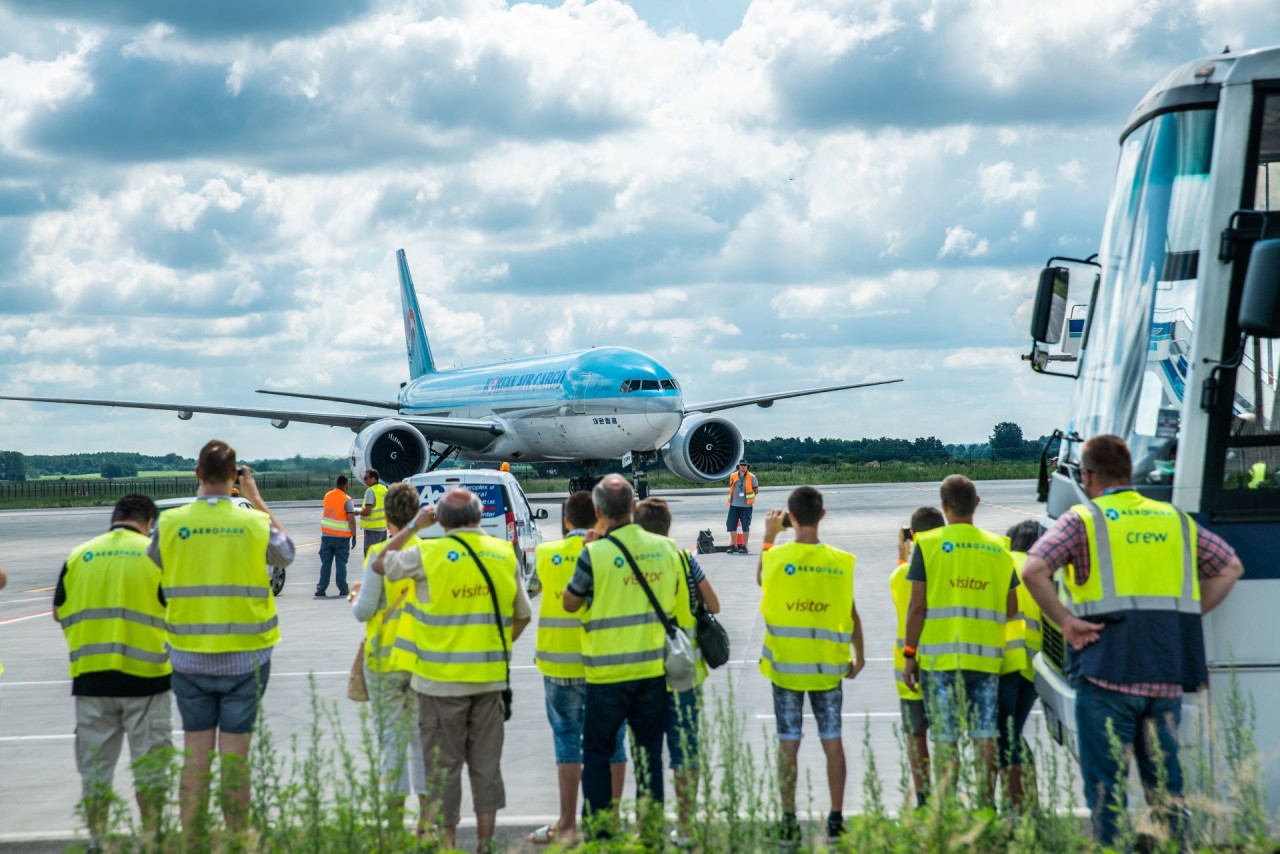
Get ready for an adrenaline rush at Budapest’s Liszt Ferenc International Airport from April 9-12, 2026 (Thursday to Sunday). Individual, group, and nighttime tours at Aeropark promise retro vibes, jaw-dropping sights, and massive planes up close. Peek behind the scenes that you never see as a passenger. Spots are filling fast—grab yours for day or night in this mysterious mini-city. Don’t miss diving into aviation’s hidden world right here in Budapest’s 18th district, Pestszentlőrinc-Pestszentimre.
Airport Tours and Hangar Treks Day and Night
Join us backstage at Liszt Ferenc International Airport for bus tours revealing aviation secrets up close. Imagine a self-contained mini-city in the big city, complete with its own wells, waterworks, purification plant, and power station. Did you know a hundred people swarm like clockwork the second a plane lands, turning it around in 30 minutes for takeoff? Most air traffic control happens off-site, not in the tower or even on the airport grounds. Have you seen the runway lights, radars, control tower, or fire station up close? If not, hop on our tour of Budapest Airport!
The runways glow—even the concrete shines. They endure hundreds of tons on impact. Ferihegy boasts two bayonet-style runways for arrivals and departures: one 3009 meters long, the other 3707 meters. A runway, or strip, is a long, straight, wide path of concrete or asphalt where planes accelerate to takeoff speed for lift or brake after landing to exit via taxiways. Directions follow prevailing winds and avoid obstacles; lengths, widths, load capacities, and configurations suit the largest planes using them. Forget “runway” for fashion catwalks or zoos—airport lingo rules.
What’s Buzzing on the Aprons? Taxiways Explained
Planes park on aprons. Traffic aprons “turn around” aircraft between gates for boarding, fueling, and loading—passengers on, bags too. Cargo aprons swap people for freight handling. Tech aprons near hangars hold planes for maintenance or, post-check, awaiting service. Taxiways, narrower than runways, weave a maze connecting everything for efficient taxiing.
Pilots navigate via 70 cm-thick sturdy surfaces marked with paint, lights, and signs—crucial in fog. Budapest Airport has 5,500 navigation lights, mostly energy-saving LEDs, regularly calibrated. Both runways offer world-class ILS (Instrument Landing System) from either direction.
Runway Codes: 13R and 31L Mystery
Numbers like “1” or “2” refer to construction order; names come from magnetic heading divided by 10 (rounded). Parallels add L (left) or R (right). Approach from Monor? Runway 2 is 31R. From Rákoshegy? It’s 13L. Giant numbers, distorted for 3-degree glide paths, mark thresholds after zebra stripes. Taxiway and apron markings follow global standards—complex like sewing patterns. Lines and colors guide safe moves amid ground gear and precise docking at gates. Painted octagonal red STOP signs with plane icons indicate where to yield to taxiing jets.
Runways need constant TLC: winter snow clearing, rubber scraping from touchdown zones, joint repairs, lamp fixes. Lights get calibrated from planes or ground rigs.
A Dash of History
Ferihegy started as an egg-shaped meadow; service roads and wild orange hedges trace Runway 1’s old fence. 1920s-30s planes, light and wind-sensitive, needed headwind takeoffs—windsocks showed direction. Heavier jets demanded paved strips; directions followed worn grass paths. Northwest winds set Runway 1’s course. Paved to 1500m by its 1950 opening, it was extended to 2500m then 3009m. The planned cross-runway was never built as jets handled crosswinds better.
The Runway 2 idea hit in the 1970s—not for capacity (Gatwick does 30 million on one), but as backup since Ferihegy was Hungary’s sole international hub. Parallel to Runway 1, 1600m offset for independent ops, bayonet layout cuts taxi times. Segregating arrivals and departures boosts hourly ops. Land on 31R? Straight to Terminal 2. Depart? Quick hop to 31L threshold. Runway 2: 3707m long, 45m wide (60m with 7.5m shoulders each), 23m elevation drop (under 1% slope limit). Approach lights and ILS for bad weather. Opened 1983.
Runway Run
For nine years, late summer sees runners, not wheels, pounding Runway 1. 1,100 aviation pros race for charity. Budapest Airport’s Runway Run fees fund Hungarian SUHANJ! programs and UK Anthony Nolan’s kids’ bone marrow transplants.
Craving more Ferihegy secrets? Join a tour! Our route hits passenger- and staff-forbidden zones. We’ll check out the…