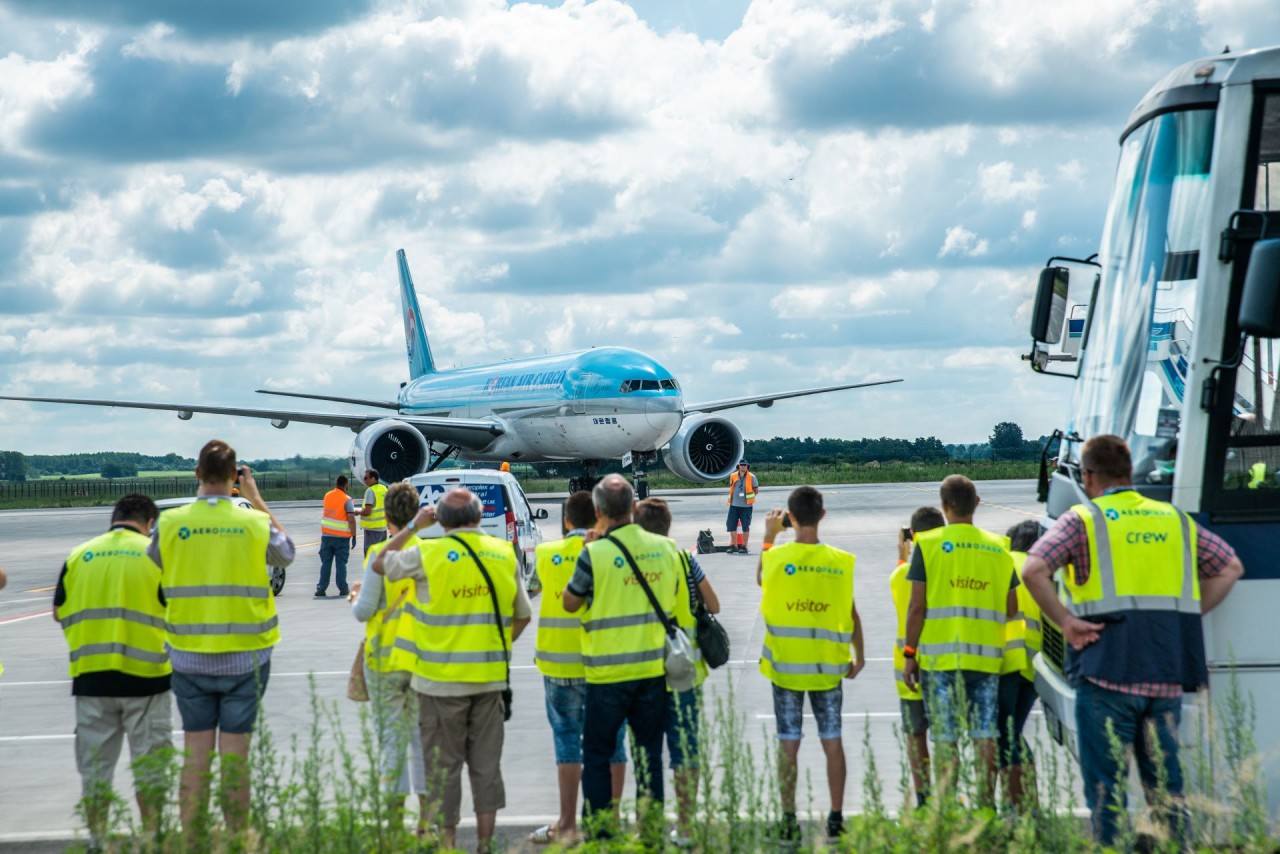
Retro vibes, big aircraft up close, and a backstage pass to a city within the city. Airport tour dates for 2025 and 2026 are now open at Aeropark, with daytime, group, individual, and night options. Pick a time and join us, whether by day or after dark, to explore the hidden world of air travel at Budapest’s Ferenc Liszt International Airport (Liszt Ferenc). Don’t miss out—step into the mysterious side of aviation you never see as a passenger.
Day and Night: Explore the Airfield and Hangars
These bus tours take you deep into areas most people never access. You’ll get a close look at aircraft operations by day and by night, when the runways light up and the airport reveals an entirely different personality. Guided by experts, you’ll see how this complex operation works minute by minute.
A Secret Small City Inside Budapest
Ferenc Liszt International Airport (Liszt Ferenc) functions like its own small town. It has its own wells and waterworks, a wastewater treatment plant, and a heating power station. Once an aircraft lands, a small army—dozens of specialists working to a second-perfect choreography—springs into action to turn it around and send it back into the air within about 30 minutes. And here’s a twist: most air traffic control doesn’t actually happen in the tower, and much of it doesn’t even happen on the airport grounds. On the tour, you’ll see why.
Runways That Glow and Take a Beating
This is the place where even the concrete shines. The surfaces must withstand the impact of hundreds of tons coming down at speed. Ferihegy operates two so‑called bayonet-system runways serving departing and arriving traffic. One measures 3009 meters (about 9873 feet), the other 3707 meters (about 12,162 feet).
What a Runway Really Is
A runway is a long, wide, straight strip of concrete or asphalt where aircraft accelerate to reach the speed needed for lift, and where they decelerate after touchdown before exiting via designated turnoffs. Its orientation is chosen based on prevailing winds and nearby obstacles, while length, width, load-bearing capacity, and equipment are set to match the airport’s role and its reference aircraft types. Aviation terminology avoids the word “kifutópálya” (runway)—that’s for fashion runways or zoos, not airports.
Aprons and Taxiways: Where the Action Happens
Aircraft park on aprons. On the main aprons, planes only stay between flights long enough for boarding, deboarding, refueling, and loading. Cargo aprons do the same for freight, while technical aprons near hangars hold aircraft awaiting scheduled maintenance or returning to service after it’s done. Taxiways connect runways to aprons in a labyrinth designed to move aircraft efficiently.
How Pilots Find Their Way
Runways, taxiways, and aprons sit on a unified load-bearing structure about 27.6 inches thick. Markings, lighting, and signage guide pilots, especially in poor visibility. Budapest boasts some 5500 navigational light sources, many now LED for efficiency and longevity. Both runways are equipped on both ends with a world-class Instrument Landing System (ILS), ensuring safe approaches in low visibility.
Why 13L/31R?
Runways are numbered by their magnetic heading with the last digit dropped. Parallel runways add L or R for left/right. So the second runway, approached from Monor, is 31R; from Rákoshegy, the same strip is 13L. These huge markings—distorted to match the 3‑degree glide slope—sit just beyond the zebra-like threshold stripes. The apron and taxiway markings follow international standards and can look as intricate as a Burda sewing pattern to outsiders. Even the red octagonal STOP appears on concrete here, with an aircraft symbol reminding ground vehicle drivers to yield to taxiing planes.
Keeping the Pavement Perfect
Maintenance is relentless: winter snow clearance, rubber removal in touchdown zones, sealing expansion joints, and servicing in-pavement and frangible-mounted lights along the runways. Many lights must be regularly calibrated from aircraft or specialized ground equipment to maintain correct angles.
From Meadow to Modern Hub
Like most early airfields, Ferihegy started as an oval grazing field. You can still trace its outline around Runway 1 in today’s service roads and the hardy hedge of wild orange that once stood in for a fence. In the 1920s–30s, aircraft were lighter and engines weaker, making them more wind-sensitive and requiring strict headwind takeoffs and landings, guided by the red-white windsock—the buló (windsock).
Paved runways arrived as aircraft grew heavier. Their direction often followed the most “worn” grass, which indicated the prevailing traffic flow. At Ferihegy, northwesterly winds set the first runway’s orientation. A 1500‑meter (4921‑foot) paved runway opened in 1950 and was later extended to 2500 meters, then 3009 meters. A crosswind runway was once considered—its stub was visible halfway along the main strip in old aerials—but as aircraft improved and tolerated crosswinds better, it was never built.
The Second Runway: A Textbook Solution
In the 1970s, planners argued for a second runway not just for capacity—London Gatwick handles up to 30 million passengers with one—but for national resilience: Ferihegy was Hungary’s only public international airport. If the single runway closed, air traffic stopped. The new runway mirrors the old orientation to match prevailing winds and maximize throughput: two parallel runways separated by adequate distance can handle far more traffic than two that intersect.
The axes are 1600 meters (5249 feet) apart and offset southeast in a Z, or bayonet, configuration to minimize taxi distances. Capacity climbs when one runway handles arrivals and the other departures. Aircraft approaching on heading 310 to land on 31 Right can roll straight to Terminal 2; departures barely taxi before lining up at 31 Left on Runway 1.
The second runway is 3707 meters long (12,162 feet) and 45 meters wide (147.6 feet), with two 7.5‑meter (24.6‑foot) paved shoulders for a total of 60 meters (196.9 feet). There’s a 23‑meter (75.5‑foot) elevation difference end to end—still well within the 1% slope allowed internationally. Top-tier lighting and ILS keep operations safe in poor visibility. The new runway opened in 1983.
Runway Run: Sneakers on the Strip
Every late summer for nine years, there’s been one day when running shoes replace landing gear on Runway 1. About 1100 participants from the global aviation community race for charity in the Runway Run. Entry fees support the Hungarian SUHANJ! Foundation’s programs and the UK’s Anthony Nolan charity for children’s bone marrow transplants, via Budapest Airport.
Your Tour Route
The bus tour takes you to zones off-limits not only to passengers but even to many airport staff. You’ll see traffic and technical aprons, runways, navigation systems, radars, and a stack of previously hidden locations—including the fire station and control infrastructure—up close. Ready to see Budapest Airport from the inside? Join us for an airport tour.
Sign Up
Registration for airport visits is open. Visitor slots are available for individual, group, and night tours.