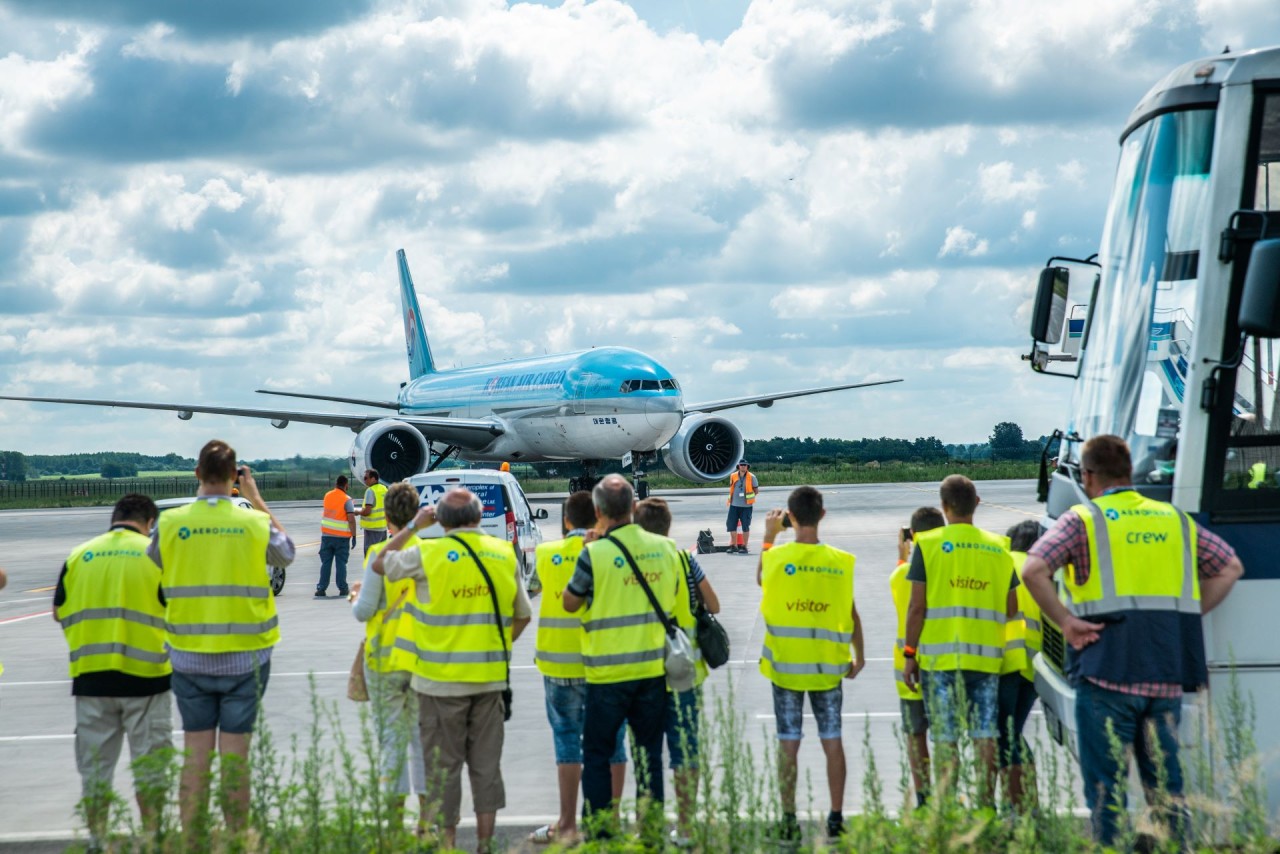
Mark your calendars for April 3-6, 2026 – that’s Friday to Monday – when you can dive into individual, group, or nighttime tours of the airport at Aeropark right by Budapest Ferenc Liszt International Airport (Liszt Ferenc Nemzetközi Repülőtér) in postal code 1185, 18th district, Pestszentlőrinc–Pestszentimre. Picture this: massive planes up close, retro vibes, pure thrill. We’re talking about the airport’s hidden side you never see as a passenger. Slots are open now – pick daytime or evening and join us in this secret little city. Don’t miss out on the magic of aviation’s mysterious world, right behind the scenes at Ferenc Liszt.
Airport Tours
Daytime and nighttime tours plus hangar walks await. Hop on our bus and get up close to the airport’s backstage action, from giant jets to glowing runways.
Mysterious Little Town – Behind the Scenes
Did you know Budapest Ferenc Liszt International Airport (Ferihegy) is its own mini-city, complete with wells, waterworks, purification plants, and a power station? Or that after a plane lands, 100 people perform a precise choreography to get it airborne again in just 30 minutes? Most air traffic control doesn’t even happen in the tower or on the airport grounds. Ever seen the runway lights, radars, control tower, or fire station up close? If not, our bus tour of Budapest Ferenc Liszt International Airport is your ticket. The concrete even glows here, built to handle hundreds of tons slamming down. Ferihegy boasts two bayonet-style runways: one 3009 meters long, the other 3707 meters.
What is a Runway?
The runway – or takeoff and landing strip – is a long, straight, wide path paved with concrete or asphalt. Planes accelerate to gain lift-off speed, then brake hard after touchdown to exit at a taxiway. Directions follow dominant winds and nearby obstacles, natural or man-made. Length, width, load capacity, and bearing strength match the biggest planes using it and the airport’s role. Note: we say runway, not “runway” like in fashion shows or zoos.
What Happens on the Apron? What’s a Taxiway?
Planes park on aprons. Passenger aprons are for quick turnarounds between gates – boarding, fueling, loading. Cargo aprons handle goods instead. Maintenance aprons near hangars hold planes for checks or awaiting recertification. Taxiways, narrower than runways, weave a network connecting everything for efficient taxiing.
How Do Pilots Orient?
Runways, taxiways, and aprons share a uniform 70 cm-thick, heavy-duty structure. Markings, lights, and edge signs guide the way, crucial in poor visibility. Ferenc Liszt has 5500 navigation lights, mostly LEDs now for efficiency and longevity, regularly calibrated. Both runways offer world-class ILS (Instrument Landing System) from either direction.
Runway Directions: Why 13R and 31L?
Numbers indicate construction order – 1 or 2 – but navigation uses magnetic azimuth from north, dropping the zero. Parallels add L for left, R for right. So runway 2 is 31R from the Monor side, 13L from Rákoshegy. Giant numbers, painted in perspective for the 3-degree glide path, mark the thresholds after zebra stripes. Taxiway and apron markings look like complex sewing patterns but follow global standards. Line types, colors, and symbols let planes weave safely amid ground gear, maneuvering precisely at gates. Even octagonal red STOP signs appear, painted with plane icons to instruct yielding to taxiing aircraft. Runways need constant upkeep: winter snow clearing, rubber scraping from touchdown zones, joint refills, lamp maintenance in slots or trenches. Many lights get angle-calibrated using planes or ground tools.
A Bit of History
Ferihegy started as an egg-shaped meadow, traced today by service roads and wild orange hedges that once served as fencing. Early 1920s-30s planes were light, weak-engined, wind-sensitive, needing headwind takeoffs flagged by red-and-white windsocks. Heavier jets demanded paved surfaces; directions followed worn grass paths dictated by prevailing northwest winds, setting runway 1. Paved to 1500 meters for its 1950 opening, it was extended to 2500 then 3009 meters. Old photos show a planned northeast-southwest cross-runway stub, but tougher jets handled crosswinds better, so it stayed a dream. The second runway idea emerged in the 1970s, not for capacity (Gatwick handles 30 million on one) but strategy – Hungary had only one public international airport; closing it halted all flights. Perfect parallel design: same direction, 1600 meters apart for independent ops, southeast offset for bayonet layout minimizing taxi distances. It boosts capacity by splitting arrivals and departures. A 310-degree inbound jet lands on 31R, rolls straight to Terminal 2; departures barely taxi to 31L on runway 1. Runway 2: 3707 meters long, 45 meters wide (60 with 7.5-meter shoulders each side), with a 23-meter elevation drop – fine under the 1% max slope rule. Top-tier lights and ILS ensure safety in fog. Opened 1983.
Runway Run
For nine years, late summer sees sneakers pounding runway 1 instead of landing gear. Runway Run draws 1,100 aviation pros for charity. Entry fees fund Hungarian SUHANJ! Foundation programs and UK Anthony Nolan’s kids’ bone marrow transplants via Budapest Airport.
The Airport Tour Route
Our tours hit spots off-limits even to most staff. We’ll check out…