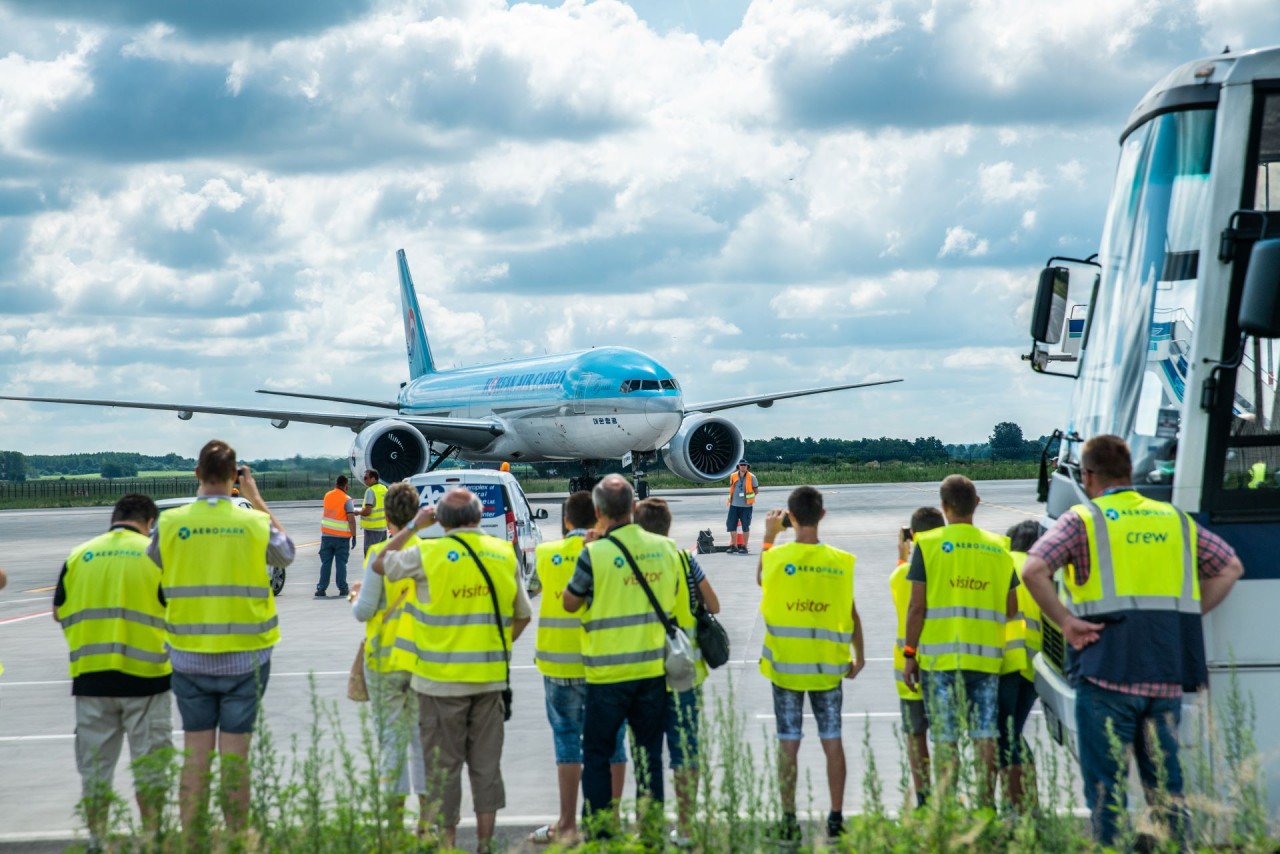
Retro vibes, up-close action, pure spectacle. See the big birds at arm’s length and discover parts of Budapest’s Liszt Ferenc International Airport you’ll never glimpse as a passenger. Guaranteed tour dates for 2025 are live now. Pick a slot and join us by day or night in this self-contained little city. Don’t miss out—step behind the scenes and get face-to-face with the mysteries of aviation on Aeropark’s airport tours.
Day, Night, and Hangar Tours
Explore the airport’s hidden zones on guided bus tours—daylight for the bustle, nighttime for the glow. We’ll roll past runways, radar sites, an honest-to-goodness fire station, and the control tower’s neighborhood, then slip into hangar territory for tech-side stories and maintenance magic. If you’ve never stood beside runway lights, watched aircraft taxi nose-to-nose, or seen where a choreographed army services a jet in 30 minutes flat, this is your invitation.
Inside a City Within a City
Liszt Ferenc is its own mini metropolis, complete with wells, a waterworks, purification systems, and a heat and power plant. Most air traffic control doesn’t even happen inside the tower—or on the airport grounds. And when a plane lands, think a hundred-strong team hitting marks to the second—refuel, unload, load, clean, inspect, push back—so the aircraft is airborne again half an hour later. You’ll get close to the systems and people who make that clockwork happen.
Where Even the Concrete Shines
This is the surface that absorbs the touchdown of machines weighing hundreds of tons. Ferihegy (Ferihegy) runs two “bayonet” or Z-offset runways for arriving and departing flights: one measures 3009 meters (9873 feet), the other 3707 meters (12,162 feet). We’ll talk runway anatomy—why they’re long, wide, dead straight; how aircraft accelerate to liftoff speed or brake hard after landing; what determines direction, length, and strength; and why “runway” beats “catwalk” every time in airport lingo.
Aprons, Taxiways, and Turnarounds
Aircraft live on aprons—traffic aprons for speedy turnarounds where passengers board and bags and fuel flow; cargo aprons for freight handling; and technical aprons near hangars for scheduled maintenance and post-service checks. Taxiways, narrower than runways, weave these areas together in a complex grid that keeps movement fast and safe. Everything sits on a unified load-bearing structure 27.5 inches thick, built for relentless punishment.
How Pilots Navigate the Maze
Pilots rely on markings, lighting, and signage—especially when visibility tanks. Budapest’s airfield boasts 5,500 lighting units, most now LED for efficiency and longevity, with regular calibration to keep approach paths razor-true. Both runways, in both directions, are equipped with top-tier Instrument Landing Systems (ILS), so operations can continue safely in poor weather.
Why 13R and 31L?
Runway numbers come from their magnetic heading, minus the last digit, with L and R marking left and right when there are parallel strips. Budapest’s second runway, seen from Monor, reads 31R; from Rákoshegy, it’s 13L. Those giant numerals and zebra-like threshold stripes aren’t art—they’re lifelines. Apron markings follow strict international standards and look as tangled as a sewing pattern to outsiders, but they guide jets to the inch among busy ground vehicles. Even the octagonal red STOP sign exists on concrete—complete with a little airplane icon signaling right of way to taxiing aircraft.
All-Weather Upkeep
Runways need relentless care: snow clearance in winter; rubber removal in touchdown zones; expansion joints refreshed; in-pavement and frangible-mounted lights replaced and re-aimed. Many lights must be calibrated with special aircraft or ground rigs to preserve the precise glidepath angles that bring jets in smoothly.
From Pasture to Powerhouse
Like early fields worldwide, Ferihegy (Ferihegy) began as an oval meadow. Its edges still trace around Runway 1 via service roads and a hedgerow of wild orange bushes that once doubled as fencing. In the 1920s–30s, aircraft were light and wind-sensitive, so pilots had to land and take off straight into the breeze. Headings and directions were read from a red-and-white windsock called the buló (buló). As planes grew heavier and stronger, grass gave way to paved runways, their axes chosen by the most “worn” grass lanes—which, in Budapest, pointed northwest with the prevailing wind.
Extending the First Runway
The first paved strip, 1500 meters (4921 feet), opened in 1950 with the airport. It was extended twice—to 2500 meters (8202 feet), then 3009 meters (9873 feet). A crosswind runway was once sketched in—its stub was visible halfway along in old photos—but aircraft evolved to handle crosswinds, so the northeast–southwest strip was never built.
The Case for a Second Runway
In the 1970s, planners pursued a second runway. Not because capacity was maxed—Gatwick handles huge numbers on one—but as a national safeguard. Ferihegy (Ferihegy) was Hungary’s only public international airport; close one runway, and the country’s air traffic would freeze. The ideal solution: a parallel runway, same orientation, spaced for independent operations. Enter the bayonet layout: the new strip sits 1600 meters (5249 feet) from the old, offset southeast in a Z to minimize taxi time and boost throughput. With arrivals on one runway and departures on the other, hourly movements climb. Aircraft landing on 31R can roll straight to Terminal 2; departures barely taxi before lining up for 31L.
Meet Runway 2
The “new” runway, commissioned in 1983, stretches 3707 meters (12,162 feet) long and 45 meters (147.6 feet) wide—60 meters (196.9 feet) including two 24.6-foot paved shoulders. There’s a 75-foot elevation difference from end to end, well within the 1% gradient allowed globally. World-class lighting and ILS keep the airport moving safely in low visibility.
Runway Run: Sneakers Over Wheels
Once a year for nine years running, the first runway turns into a racetrack—no landing gear, just trainers pounding concrete. Around 1,100 participants from the global aviation community line up to raise money. Entry fees support the Hungarian SUHANJ! Foundation’s inclusive sports programs and the UK’s Anthony Nolan charity for children’s bone marrow transplants.
Your Turn to Go Airside
Curious for more? Join the tour. We’ll take you onto restricted grounds beyond what even most airport staff see. Expect traffic and technical aprons, runways, navigation arrays, radars, and a grab bag of spots that were off-limits—until now.