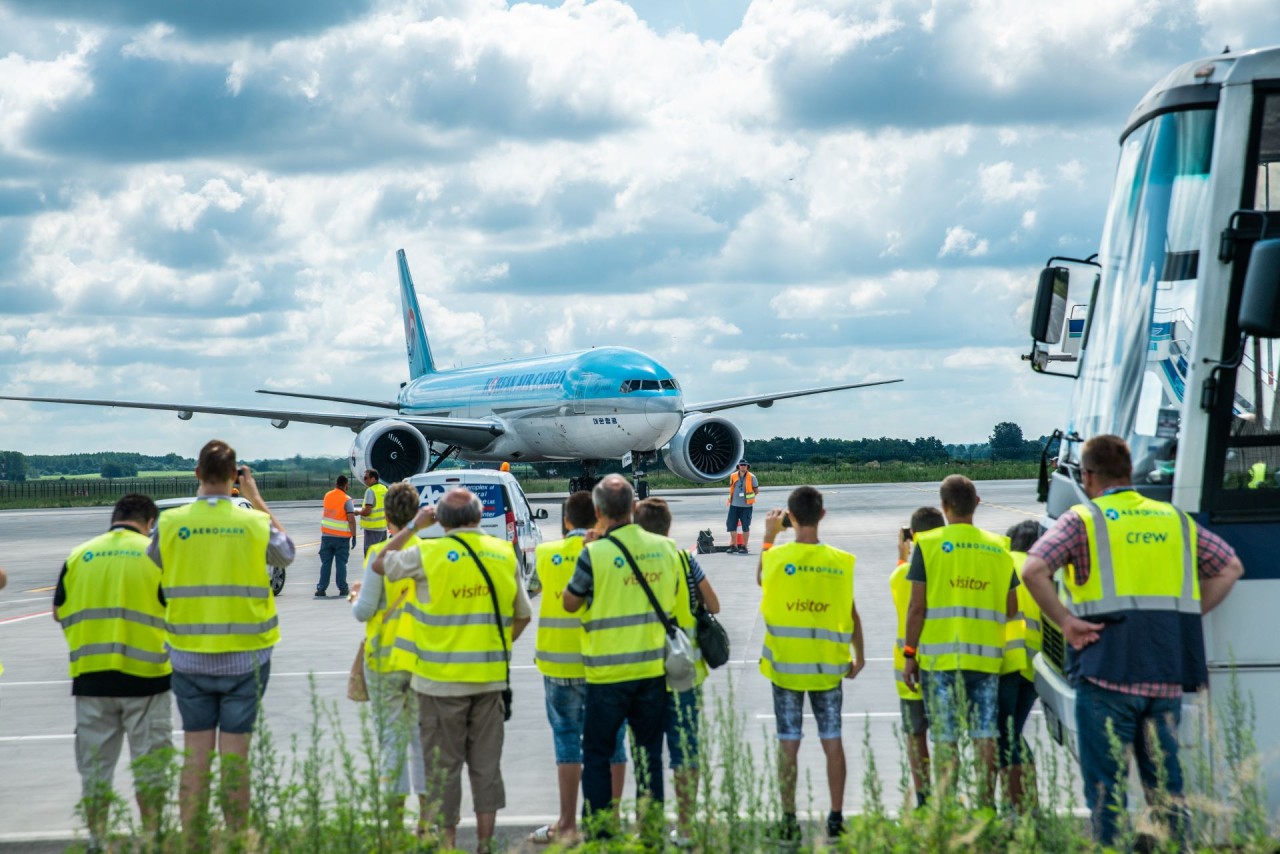
Retro vibes, real engines, jaw-dropping views. Get up close to the big birds and see Budapest’s Ferenc Liszt International Airport (Liszt Ferenc Nemzetközi Repülőtér) like you never can as a passenger. Guaranteed dates for airport tours are now live for 2025 and 2026, with daytime, evening, and even night options starting December 27–28, 2025. Pick a slot and come explore this secretive little city within the city. Don’t miss the experience—step behind the scenes and discover aviation’s hidden world at arm’s length.
By Day or Night: Hangars, Aprons, and Lights
The bus tour takes you past places closed not only to travelers but even to most airport staff. You’ll roll by the traffic and technical aprons, peek at the runways, and get close to the navigation gear, radars, and the control tower. You’ll see apron choreography in action, runway edge lights glowing like a constellation, and the fire station up close. If you’ve never seen the runway lights or the vast radar antennas from a few yards away, now’s your chance.
A City Within the City
Ferenc Liszt International is a self-contained micro-city. It runs on its own wells and waterworks, has a water treatment facility, and even a heating plant to keep the machine humming. When a plane touches down, it’s like a perfectly timed stage show: dozens upon dozens of people execute a to-the-second routine so the jet can push back roughly 30 minutes later. And here’s a surprise—most air traffic control doesn’t happen in the tower, and not even strictly at the airport itself.
Where Even the Concrete Shines
Runways at Ferihegy are built to absorb the earth-shaking arrival of hundreds-of-tons aircraft. The airport operates two offset, “bayonet” system runways to serve departures and arrivals. One measures 3,009 meters (about 9,871 feet), the other 3,707 meters (about 12,162 feet). A runway is a long, straight stretch of concrete or asphalt where aircraft accelerate to takeoff speed and, after landing, brake to exit safely. Their orientation is set by prevailing winds and surrounding obstacles; dimensions and load-bearing specs follow the aircraft types and the airport’s intended role. And no, “kifutópálya” isn’t airport lingo—that word belongs on catwalks and in zoos, not here.
Aprons and Taxiways: The Airport’s Pulse
Aircraft park on aprons. On the traffic apron, planes turn around between two flights: passengers off and on, refueling, loading, and unloading in a tight window. Cargo aprons do the same, minus passengers, plus freight. Technical aprons near hangars host jets awaiting scheduled maintenance or freshly serviced aircraft ready to re-enter the fleet. Taxiways knit together runways and aprons in a maze designed to move aircraft efficiently—narrower than runways but crucial to the flow.
How Pilots Navigate the Maze
Runways, taxiways, and aprons sit on a unified, 27.6-inch-thick load-bearing structure. Markings, lighting, and guidance signs do the heavy lifting—especially when visibility drops. Budapest’s airfield packs around 5,500 navigation light sources, many now LED for efficiency and lifespan. Both runways are equipped on both ends with world-class Instrument Landing System (ILS) gear. You’ll even spot the familiar red octagonal STOP on the concrete—but with a small airplane icon reminding ground drivers to yield to moving aircraft.
Why 13L/31R? The Numbers Decoded
The “1” and “2” runway labels only mark the build order. The operational names come from their magnetic bearing rounded to two digits, plus a letter if there are parallels: L for left, R for right. Approach from Monor and you’re on 31R; from Rákoshegy, that same strip reads 13L. These huge codes are painted at each threshold after zebra-like markings, distorted to be read along the 3-degree glide path. The apron and taxiway paint symphony, standardized worldwide, looks as complex as a Burda sewing pattern to outsiders but lets pilots thread the needle to within inches at passenger bridges.
Maintenance Is a Year-Round Sport
Both runways get constant care. Winter brings snow clearing; year-round, rubber buildup around touchdown zones must be stripped, expansion joints renewed, and in-pavement or frangible-mounted lights replaced and recalibrated from aircraft or special ground rigs.
From Pastures to Precision
Like many early airfields, Ferihegy began as an oval pasture, its outline still traced by a service road and a thorny hedge once used as a living fence. Lightweight aircraft in the 1920s–30s were wind-sensitive, taking off and landing strictly into the wind, guided by a red-white windsock, the buló. As heavier, more capable planes arrived, paved runways became essential. The first paved, 1,500-meter strip opened in 1950; later, it stretched to 2,500 and then 3,009 meters. A crosswind runway was once sketched out northeast–southwest, but stronger aircraft made it unnecessary.
Why Build a Second Runway?
The idea surfaced in the 1970s, not just for capacity—London Gatwick proved a single runway can handle tens of millions—but as a strategic must. With Ferihegy the country’s only public international field, closing a single runway would freeze national air traffic. The new runway copied the original’s heading to match prevailing northwesterlies, while parallel placement boosts throughput far beyond intersecting designs. Set 1,600 meters (about 5,249 feet) from the first and offset southeast into a Z-shape, it slashes taxi times and allows independent operations. Arrivals can flow on one, departures on the other, raising hourly movements. Jets landing on 31R can roll straight toward Terminal 2; departing traffic needs only a short taxi to the 31L threshold.
The Numbers on the New Strip
Commissioned in 1983, Runway 2 runs 3,707 meters long and 45 meters wide—60 meters including two 24.6-inch paved shoulders. The endpoints differ by 23 meters in elevation, well within the 1% slope allowed by international rules—up to 37 meters would still pass. Even in low visibility, best-in-class lighting and ILS keep operations safe and continuous.
Runway Run: Sneakers on the Strip
Every late summer for nine years running, one day flips the script: instead of landing gear, running shoes pound Runway 1. Around 1,100 people from the global aviation community race the Budapest Airport Runway Run, with entry fees supporting the Hungarian SUHANJ! Foundation’s programs and the UK’s Anthony Nolan foundation for children’s bone marrow transplants.
Ready to go deeper into Ferihegy’s backstage? Hop on the Aeropark bus and see what the airport looks like when the curtain lifts. You’ll never look at takeoffs and landings the same way again.