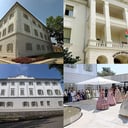
On 2 Szent György Square, a sweeping retrospective brings the fearless color and abstract experimentation of Hungarian expressionist and avant-garde master Lajos Tihanyi (Tihanyi Lajos) into sharp focus. Nearly two hundred works—his most important paintings and graphics, plus personal estate objects—trace a life disrupted early by illness yet driven by relentless invention. The show also unlocks a long-hidden legacy: until the 1970s, Hungarian audiences mostly knew Tihanyi’s art from black-and-white reproductions; only fifty-five years ago did his estate travel, in dramatic fashion, from Paris to the Hungarian National Gallery. Photo courtesy of the Museum of Fine Arts.
Who Was Tihanyi?
Born 140 years ago, Tihanyi lost his hearing at age eleven due to meningitis; his speech was altered, he lip-read, and he never completed academic training. That outsider’s perspective forged a strikingly personal visual language. As a young man he visited Nagybánya (Baia Mare), befriended painters and writers, and moved within the era’s intellectual circles. In the winter of 1919 he emigrated and never returned to Hungary, living in Vienna, Berlin, Paris, then New York, and eventually back in Paris in the 1930s. A central figure of the group The Eight (Nyolcak), he held a solo show in 1918 at the Kassák-led MA exhibition space—already a noted artist when he left the country.
Portraits, Circles, Cities
In Berlin and Paris, Tihanyi plugged into the international avant-garde, meeting key figures and refining a portrait style many compared to Oskar Kokoschka’s for its expressive force. He painted a roll call of cultural heavyweights: Hungarian luminaries like Lajos Kassák (Kassák Lajos), Lajos Fülep (Fülep Lajos), Endre Ady (Ady Endre), Mihály Babits (Babits Mihály), Józsi Jenő Tersánszky (Tersánszky Józsi Jenő), Dezső Kosztolányi (Kosztolányi Dezső), Pál Pátzay (Pátzay Pál), and György Bölöni (Bölöni György), alongside international names including Ivan Goll, Diego Rivera, Tristan Tzara, Marinetti, and Brassaï. In the final stretch of his career, abstraction surged; in 1932 he joined the international group Abstraction-Création, turning to taut, dynamic compositions where color and form speak on their own terms.
Tickets, Access, Practicalities
Full-price tour tickets cost about $20.40; discounted tickets are $11.60. Maximum group sizes vary by program. On-site meeting points are clearly marked—usually the ground-floor exhibition entrance or the information desk. Tickets can be purchased online or in person on a first-come, first-served basis. For some tours, the exhibition ticket is separate from a program ticket priced around $4.10.
Highlights: Curated Walkthroughs
TIHANYI 140 with curator Mariann Gergely (Gergely Mariann) (January 15, 16:00–17:00) maps the arc of a career shadowed by deafness yet heightened by a singular gaze. Expect insight into how his estate finally reached Budapest and how a self-taught artistry formed without academic guardrails. Full price: $20.40; discount: $11.60. Max 17. Meet at the ground-floor entrance.
The Man Behind the Palette with art historian Gergely Barki (Barki Gergely) (January 16, 16:00–17:00) probes personality as much as paint. Despite hearing loss and speech difficulty, Tihanyi was sociable, with friends and enemies alike, yet lived largely alone and never formed a lasting partnership—traits that may thread back into his work. Barki explores how relationships and temperament shaped the canvases. Full price: $20.40; discount: $11.60. Max 20. Ground-floor entrance.
Rebel Forms, Bold Colors
Multiple guided tours under the banner Rebel Forms, Bold Colors – The Art of Lajos Tihanyi open the show’s core narrative: a self-taught artist who found a unique voice from silence, becoming one of the most original members of The Eight (Nyolcak) and a landmark figure in 20th-century Hungarian painting. Tours run 60 minutes, max 17 people, meeting at the information desk. Participation requires an exhibition ticket plus a program ticket (~$4.10). Dates: January 17 (15:00–16:00), January 18 (11:00–12:00), January 23 (16:00–17:00), January 29 (16:00–17:00), January 31 (15:00–16:00), February 7 (11:00–12:00), February 8 (15:00–16:00).
Online Tour on Hungarian Culture Day
On January 22 (19:00–20:00), join a Zoom tour from home. After the live session, access the virtual exhibition for a full week—zoom in on artworks and study wall texts at your own pace. Fee: about $4.10 per person. Max 90. Duration: 60 minutes.
Sign-Language Interpreted Tour
On January 25 (15:00–16:00), an accessible Rebel Forms, Bold Colors tour features sign-language interpretation so hearing, hard-of-hearing, and deaf visitors can experience it together. Entry requires the exhibition ticket and the ~$4.10 program ticket. SINOSZ members attend free with advance registration by January 20. Duration: 60 minutes. Max 17. Meet at the information desk.
The Restless Charmer
On February 5 (17:00–18:00), art manager Nóra Winkler (Winkler Nóra) and art historian Tünde Topor (Topor Tünde) lead The Restless Charmer, a joint tour that reads Tihanyi’s life as an adventure and his portraiture as razor-sharp psychological study. A founder of The Eight (Nyolcak), he painted an entire gallery of early-20th-century Hungarian cultural figures and often returned to self-portraiture. The late abstractions get their due, too. What do these works say to us today? Full price: $20.40; discount: $11.60. Max 36. Ground-floor entrance. After the tour, visit independently until 18:45.
Budapest–Berlin–Paris
On February 6 (16:00–17:00), writer and art historian Rita Halász (Halász Rita) traces Tihanyi’s path from café-culture Budapest to Berlin’s avant-garde and Parisian modernism, tracking the move from figurative scenes to a pure language of color and shape. Full price: $20.40; discount: $11.60. Max 20. Ground-floor entrance.
Dates and City
Upcoming Budapest dates include January 22, 23, 25, 29, 31, and February 5, 6, 7, 8. The address is 1014 Budapest, 2 Szent György Square (Szent György tér 2). For inquiries, contact the organizers via the listed email and phone numbers.