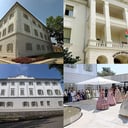
The Hungarian National Gallery (Magyar Nemzeti Galéria) is Hungary’s largest public collection tracing how the country’s visual arts took shape and evolved. Inside the former Royal Palace, visitors find permanent and temporary exhibitions, guided tours in Hungarian and foreign languages, themed programs, family days, festivals, and concerts. Kids can join creative clubs, art education workshops, and summer camps designed to turn gallery visits into hands-on adventures.
From late December through January, the calendar is stacked—led by a sweeping retrospective honoring the 140th anniversary of painter and graphic artist Lajos Tihanyi. Alongside that are intimate tours of specific exhibitions, kids’ sleuthing sessions, baby-friendly mornings, and even an architectural walk that climbs from a Habsburg crypt to the palace dome with its knockout panorama of Budapest.
Rebel Forms, Daring Colors: Lajos Tihanyi
Running on multiple dates—December 28, 29, 30, and January 9, 11, 17, and 23—the show Rebel Forms, Daring Colors – The Art of Lajos Tihanyi (Lázadó formák, merész színek – Tihanyi Lajos művészete) gathers his most important paintings and graphics, plus personal objects. Tihanyi lost his hearing as a child and, from silence, conjured color and form. Without academic training, he forged a distinctive visual language that made him a defining member of The Eight (Nyolcak) and one of 20th-century Hungarian painting’s most original voices. Several dates include guided tours that delve deeper into his technique, themes, and career arc—ideal for anyone curious how a perceived limitation became the engine of a unique artistic voice.
On January 15, curator Mariann Gergely leads TIHANYI 140, spotlighting how, until the 1970s, Hungarian audiences mainly knew Tihanyi’s works from black-and-white reproductions. Fifty-five years ago, his estate arrived from Paris to the National Gallery via a winding, almost cinematic path, now forming the backbone of this career-spanning exhibition. The next day, January 16, art historian Gergely Barki offers an offbeat tour titled The Person Behind the Palette, promising a lively, insider’s read on Tihanyi. Writer and art historian Rita Halász follows on January 17 with a subjective walkthrough, Embroidered in Concrete (Betonba hímezve), adding personal interpretation to the canon.
From Crypt to Dome
On January 3, the architectural tour Building Walk – From Crypt to Dome (Épületséta – Kriptától a kupoláig) explores the former Royal Palace, home of the National Gallery. The route swings from the Habsburg Palatine Crypt to the dome, taking in hidden corners and architectural quirks while stitching together the building’s history with the story of the collection inside. It’s a backstage pass to the palace’s past—and the views alone are worth the climb.
Kids, Toddlers, Detectives
The gallery’s family programming is in full swing. On January 7, 14, and 21, the workshop series Recolor It! – Museum Workshop for Kids (Színezd újra! – múzeumi műhely gyerekeknek) turns children into art detectives. The mission: unearth Tihanyi’s secrets by closely examining dozens of his works, hunting down crucial hidden details, and assembling the bigger picture. Making is just as central as sleuthing—kids “forge” paintings, create composite “phantom” portraits, and play with photo modification.
January 13 is for the littlest visitors: Toddlers – Snowflake Dance (Tipegők – Hópihe tánc) invites toddlers to a winter-magic session in the galleries. With songs, stories, and dance, the program looks at how the forest turns white and what colors lurk in snow-covered landscapes. On January 15, Look, Mom! – Silence Speaks (Mama, nézd! – A csend beszél) reframes Tihanyi’s life through his childhood illness and deafness, asking how that challenge sharpened his artistic identity and led to such singular work.
Pictures of Tranquillity and Adolf Fényes
English-speaking families get their own invite on January 8 with Look at That, Mom! – Sunny Days. This guided tour explores Pictures of Tranquillity and places the works of Adolf Fényes (1867–1945) in context, along with pieces from the permanent collection. The next day, visitors can join an Italian-language tour, Visita guidata in italiano, tracing Hungarian art’s big names and movements from the Middle Ages to today, with a special spotlight on the 19th and 20th centuries—and a playful chance encounter with Dante among the paintings.
On January 10, a focused tour on The Art of Adolf Fényes (Fényes Adolf művészete) opens windows onto rooms where sunlight floods the simplest interiors, markets bustle with storybook energy, and everyday life ranks as high as any historical tableau. As the tour moves through landscapes and intimate interiors, it asks: How does a peasant courtyard find room under the shadow of French Impressionism? What ties a veranda in Szolnok to Paris? And what do these century-old genre scenes reveal about ordinary joys and sorrows back then?
Abstract Energy, New Year, New Style
January 17’s Create! – Abstract Experience Painting (Alkoss! – Absztrakt élményfestés) puts visitors face-to-face with abstraction’s open field—where geometry, color play, and free-running brushstrokes share space. Names like Sean Scully, Judit Reigl (Reigl Judit), and Simon Hantai (Hantai Simon) set the tone. After a tour, participants paint striking abstract works of their own.
On January 21, Mental Fitness – New Year, New Style (Szellemi fitnesz – Új év, új stílus) zooms in on artists who reinvented themselves. Painters such as János Vaszary (Vaszary János), József Rippl-Rónai (Rippl-Rónai József), and Aurél Bernáth (Bernáth Aurél) worked across styles, enough to surprise viewers that very different canvases emerged from the same hand in different periods. The studio session lets participants try one of Rippl-Rónai’s styles for themselves.
Nudes, Online Access, and More Tihanyi
January 18’s Nude Sculptures from the Turn of the Century (Aktszobrok a századfordulóról) revisits one of art’s oldest themes: the nude. The guided tour of the renewed turn-of-the-century nude sculpture display shows how the portrayal of the human body keeps shifting with the ideals of its era.
On January 22, the gallery takes Tihanyi online with an at-home guided tour of the exhibition for the Day of Hungarian Culture—perfect for those who can’t get to Budapest but want to dive into the painter’s world.
And if you missed earlier dates, another in-person guided tour of Rebel Forms, Daring Colors – The Art of Lajos Tihanyi (Lázadó formák, merész színek – Tihanyi Lajos művészete) runs January 23. From silence to color, from personal adversity to artistic breakthrough, the National Gallery’s winter season frames Tihanyi as a landmark figure—and sets his legacy against the broader sweep of Hungarian art, in all its boldness and reinvention.