Gyula keeps the door open all year. Beyond the city’s icons, there are quiet corners, plaques, parks, and riverside paths that reward anyone willing to wander a little more slowly. Start with the castle and the former mansion, then keep going—Gyula hides its best stories in plain sight.
Castle, Mansion, Mist
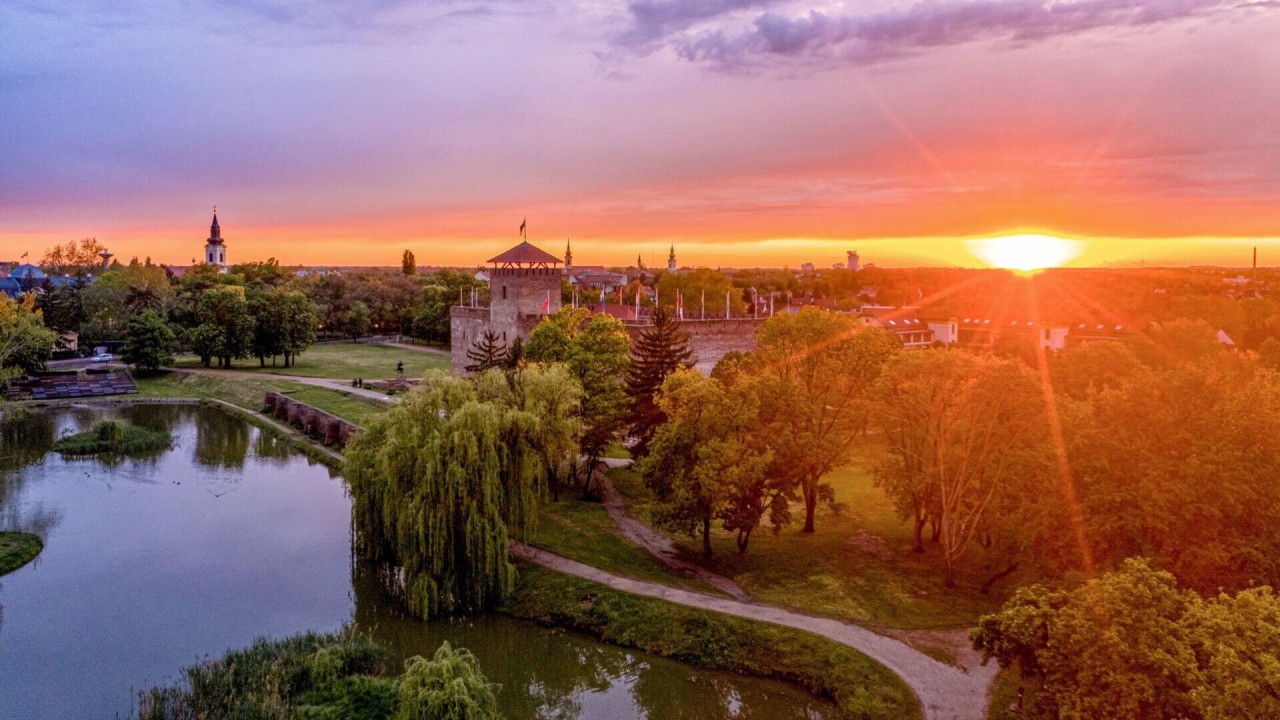
The castle and the surrounding mansion quarter always offer something interesting. In winter, leafless trees reveal more of the mansion’s imposing mass, where baronesses and countesses once gazed from upstairs windows. Fog makes the brick fortress even more mysterious than summer sun ever could. Walk the entire circuit along the old walls and hunt for fragments of towers and ramparts. On the old moat—today’s boating lake—wild ducks ignore the weather and pose for photos, especially if there’s a snack in play. When temperatures dip below freezing, long-eared owls settle in the trees between the castle and the Erkel Hotel, blinking solemnly even in daylight and barely noticing the cameras.
Stories on the Walls
Memorial plaques on house walls pop up everywhere, each one a clue to Gyula’s past. Dr. Rudolf Erkel—was he the great composer’s brother who practiced medicine? And who was Ferenc Erkel’s wife, Adél Adler? Names become questions, and streets become biographies. Mór Jókai didn’t pass Gyula by either; he stayed more than once in the beautifully restored old house. First he arrived on honeymoon with the strikingly beautiful Róza Laborfalvi; later, fleeing reprisals, he escaped toward the Bükk from here.
Two houses down, more plaques: Arzén Szarvassy worked to tame rivers that caused devastating floods. Paulina Pfiffner, a fearless patriot, fought in General Bem’s army at age 23 disguised in men’s clothes. On the opposite wall, you’ll spot the plaque of György Pomutz, son of a Romanian farrier who fought as a Hungarian officer under General Klapka, helped found New Buda in the United States, became a Union general in the American Civil War, and later served as the U.S. consul general in imperial Russia. What a life.
Faces in the Sculpture Park
The sculpture park is a roll call of familiar faces and names. Mihály Munkácsy seems to be wondering how his life would have turned out if he hadn’t met painter Elek Szamossy here in Gyula. Attila József gazes darkly toward the former orphanage; at five years old he spent three days there before being sent to foster parents in Öcsöd. Béla Bartók almost smiles when the weather’s bright—and no wonder, this is where he first heard the folk song that begins: “Csillagok, csillagok, szépen ragyogjatok!” Albrecht Dürer stands with quiet grandeur for good reason: his father, Ajtósi Albert, was born in Ajtós, just next to Gyula. Few know that. Endre Ady praised the construction of the Ferenc Erkel Summer Theater in Gyula; after his articles, many Hungarian small towns followed suit and built their own open-air stages.
The Living Water Canal
That gentle ribbon of water slicing Gyula in two is called the Living Water Canal (Élővíz-csatorna). “Canal” misleads: this isn’t man-made. It’s a branch of the ancient river system that once ran through the city, fed today from the Fehér-Körös via a sluice, the river now skirting Gyula. Even in winter, a walk among the weeping willows is calming—quiet water, muffled sound, slow air. Plan to return in summer when the light stretches late.
Snail Garden and Sissi
The Snail Garden (Csigakert) is a graceful park where, long ago, a path curled like a snail up a small hill to a slender gloriette among centuries-old trees. You’ll find a statue of Hungary’s beloved queen, Sisi, here as well. In winter, it’s often wrapped for protection so the noble Carrara marble won’t suffer from the cold.
Old Elegance, New Energy
The city center stays tidy and handsome as ever, even when the cold nudges the flowers away. Or does it? In the beds, hardy pansies hold out against the season, while trees, ornamental shrubs, and bushes frame nearly every view. It’s easy to imagine how gorgeous these streets are in spring, summer, and fall—green, blooming, lively. In warm months, people stroll day and night and fill café terraces; the old downtown hums with a Mediterranean vibe. Stately historic buildings lend elegance and a certain grounded pride to Gyula, a former county seat from the time of King Matthias all the way to 1950. During the Ottoman era, Gyula was even the center of a sanjak.
A life-size statue honors Sándor Petőfi, who stopped in town on his way to Transylvania, anxious for the nation’s fate. Ferenc Erkel, Gyula’s native son, gives his name to the freshly renewed, grand-piano-shaped square. Around his statue, illuminated granite tiles mark the notes of the Himnusz. The Hundred-Year Confectionery (Százéves cukrászda) impresses inside and out. Skeptics wonder if it’s really a hundred years old. They’re right to doubt: it’s far older, now at 180 years. Go see for yourself.
Keep Walking
After a long stroll, rest feels earned—but Gyula has plenty more up its sleeve. On another day, head to Göndöcs Garden (Göndöcs-kert), visit Ferenc Erkel’s birthplace on the old main square of Németváros, find the site of Gyula’s ancient church, and step into the Franciscan ruin garden, final resting place of King Matthias’s granddaughter and the widow of János Corvin.