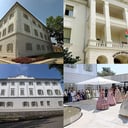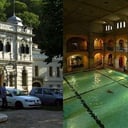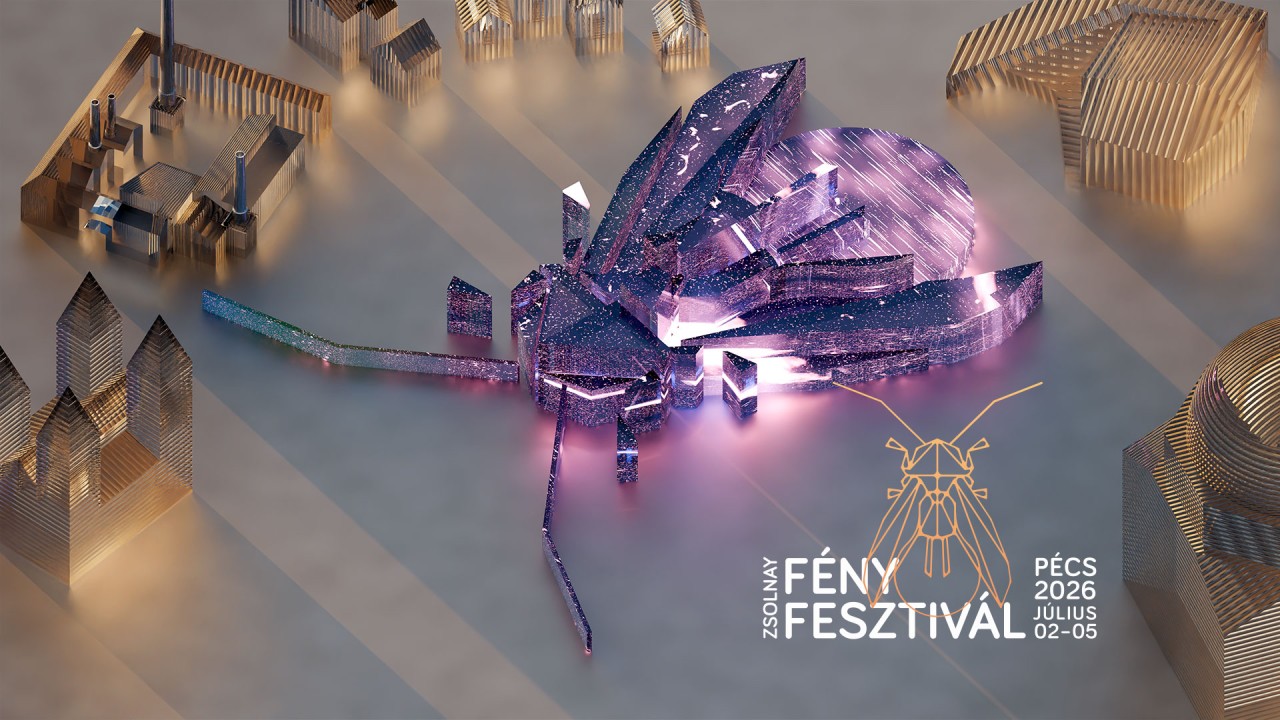
Pécs will glow for four nights as the 10th Zsolnay Light Festival (Zsolnay Fényfesztivál) takes over the city from July 2–5, 2026. After dark, Hungarian and international artists transform façades, squares, galleries, and a handful of rare, normally closed venues with site-specific light art and monumental projections. What began a decade ago as a bold urban experiment is now one of Europe’s most spectacular city festivals, drawing well over 100,000 visitors every year.
Vasarely takes center stage
This jubilee edition salutes Pécs-born giant Victor Vasarely on his 120th birthday and marks the 50th anniversary of the Vasarely Museum in the city. The year’s theme channels his PLASTI-CITÉ // COLORFUL CITY (SZÍNES VÁROS) vision, inviting everyone into a sensorial play of motion, space, and light, fueled by optical illusion and kinetic energy. More than 30 works will bathe Pécs in color and movement across four nights, with a program that deliberately blurs the line between gallery and street, audience and author.
The cathedral becomes a canvas
Nightly crowds will pack the square by Pécs Cathedral, where the Zsolnay Light Art Video Mapping Competition turns the historic façade into the festival’s largest luminous screen. This year’s finalists include creators from Italy, China, and Bulgaria, all riffing on Vasarely’s op-art legacy. An Irish focus runs through the program as well: Kiégő Izzók debuts a special homage projection honoring the life and work of Ferenc Martyn (Martyn Ferenc), adding a lyrical counterpoint to the competition’s high-octane visuals.
The Light Path: 34 stops of wonder
The festival’s backbone is the Light Path, threading 15 sites in the city center and 19 around the Zsolnay Quarter. Visitors roam at their own pace, collecting moments: immersive tunnels, responsive sculptures, and illusory architectures that warp with each step. The Zsolnay Quarter and Kodály Center form the festival’s main experience hub this year as part of Light Festival MAX (Fényfesztivál MAX), a wristband-access area packed with the boldest, most interactive installations—enough to fill an entire evening with light-driven adventures.
Immersion at Kodály and the Zsolnay Quarter
Inside the Kodály Center, Latvian collective Those Guys Lighting presents Divine Geometry, a 30-minute, audio-driven architecture in pure laser light. Twenty-four precisely choreographed beams shape-shift in a ritual of lines and volumes so intense that previous audiences were reportedly moved to tears.
In the Zsolnay Quarter’s Labor, Spanish artist Marc Vilanova invites visitors to walk through a waterfall woven from light. Nearby at E78, Playmodes builds dynamic, floating sculptures using laser beams and robotic mirrors, creating living constellations overhead. In the Pirogranite Courtyard (Pirogránit udvar), Vasarely’s op-art leaps into 3D space, a geometric illusion that continuously morphs with the viewer’s movement and rewards anyone willing to circle, crouch, and explore.
A landmark exhibition that lasts all summer
Inside the m21 Gallery, the Hommage à Vasarely by Light exhibition becomes a milestone: the first show in festival history to extend far beyond its dates, running through the end of August. It offers a deep visual journey through light-based tributes that expand on Vasarely’s ideas. Also in the Quarter, emerging artists from the Light Art Colony (Fényművésztelep) present fresh experiments in luminescence, adding new voices to a dialogue that stretches from Pécs to the global light-art scene.
City icons reborn in light
The historic Cella Septichora Visitor Center stages a pulsing, glass-encased light creature that claws at its translucent prison like a digital organism learning to breathe. Széchenyi Square is wrapped in a monumental 360-degree light panorama; on Jókai Square, the festival’s beloved totem, Pixelbogár, returns with glowing charm. Inside the Árkád mall, technology and nature meet as a vast LED wall revives the memory of water in streaming, liquid patterns.
Psychedelic nights on Theater Square (Színház tér)
Time-travel to the 1970s hippie era on Theater Square (Színház tér), where New York’s Liquid Light Lab resurrects the legendary analog light shows of the age. Think Kandinsky’s palette colliding with the guitar storms of Jimi Hendrix and early Pink Floyd—four nights of drifting, tactile color fields that swallow you whole. The station is part of the USA250 commemorations, with Tilos Rádió DJs spinning the vibes. It’s not just a projection; it’s a communal, psychedelic journey through pure light.
Street theater, family fun, late-night beats
Beyond the beams, the city fills with fire jugglers, acrobats, and roaming street troupes. Families can dive into interactive kids’ activities and glow-in-the-dark crafts. Concerts and electronic parties keep the pulse going late into the night, turning Pécs into a playground where every corner hums with performance and sound.
An Irish thread through the festival
That Irish focus extends beyond the cathedral projection: along the Light Path, an Irish-themed station pops up, while Káptalan Street hosts an Irish gastro courtyard—think taste, texture, and music shaped by the island’s culture. Expect the festival soundtrack to twist toward reels and rhythms that bounce under the glow of LEDs and lasers.
Tickets, access, and dates
City-center outdoor programs and light artworks are free. Indoor sites, the Zsolnay Quarter, and the special installations at the Kodály Center require a Light Festival MAX (Fényfesztivál MAX) wristband, on sale from May 7. The 10th Zsolnay Light Festival (Zsolnay Fényfesztivál) lights up Pécs from Thursday, July 2 to Sunday, July 5, 2026, across multiple venues in the 7630 district—four summer nights when the city becomes a living gallery and the street belongs to light.