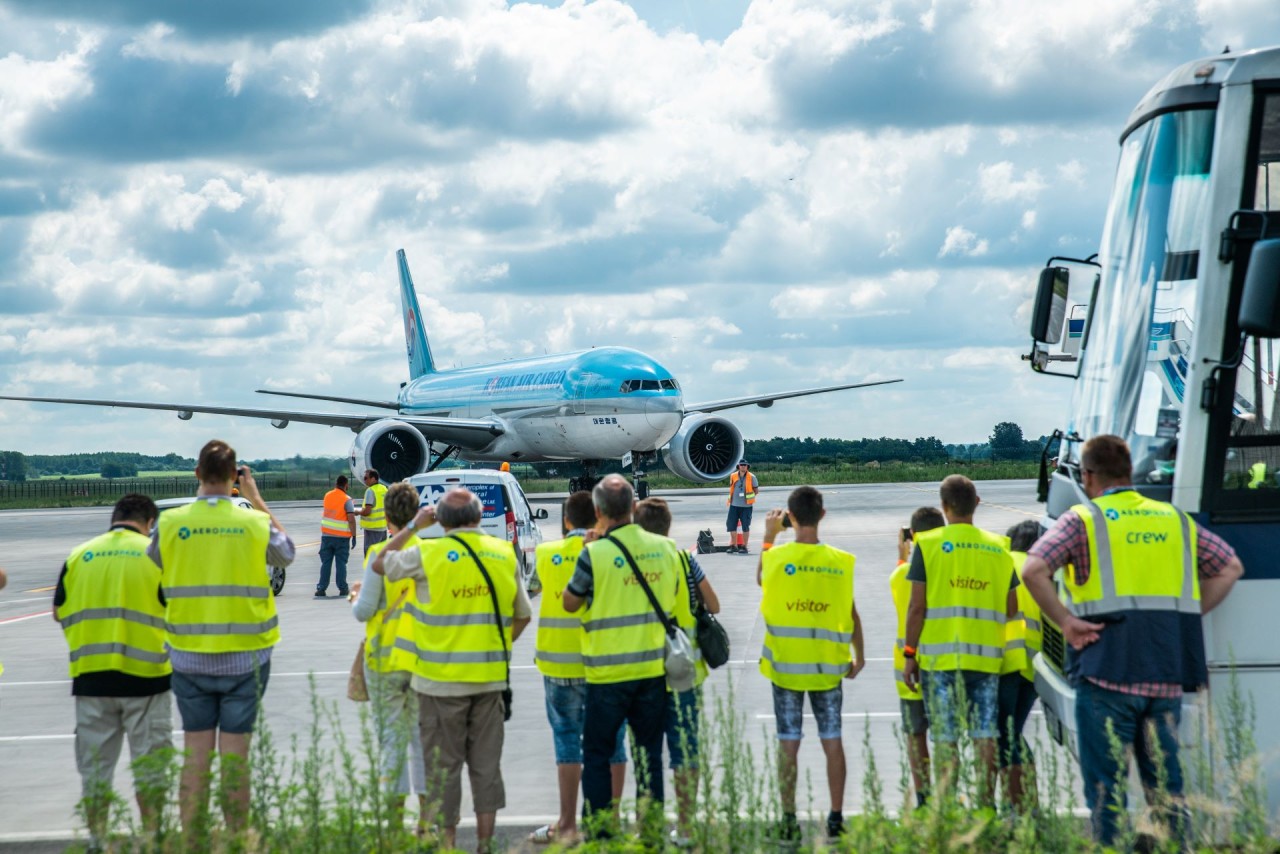
Get ready for an adrenaline rush at Budapest Ferenc Liszt International Airport from April 3 to 6, 2026—Friday to Monday. Whether solo, with a group, or under the stars, these Aeropark tours take you behind the scenes with massive planes up close. Forget passenger views; this is the real deal, a mysterious world of aviation magic. Spots are booking up fast—pick your slot and dive into this hidden mini-city buzzing with action. Don’t miss out on the thrill!
Mysterious Mini-City Behind the Curtain
Did you know Budapest Ferenc Liszt Airport operates like its own little town inside Budapest, complete with wells, waterworks, a purification plant, and a power station? After a plane lands, a hundred people spring into a precise, second-by-second choreography to get it airborne again in just 30 minutes. Most air traffic control doesn’t even happen in the tower or on the airport grounds. Ever seen the runway lights, radars, control tower, or fire station up close? If not, hop on our bus tour and explore Budapest Airport’s hidden gems.
Runways That Glow and Take the Heat
The runways here glow, built to handle hundreds of tons slamming down. Ferihegy boasts two bayonet-style runways: one 3,009 meters long, the other 3,707 meters. A runway—a landing and takeoff strip—is a long, straight, wide path of concrete or asphalt. Planes accelerate here to generate lift for takeoff or brake hard after landing to exit at a taxiway. Directions follow prevailing winds and nearby obstacles; lengths, widths, load capacities, and configurations suit the biggest planes using them. No “runway” confusion with fashion shows or zoos.
Aprons, Taxiways, and Pilot Navigation
Planes park on aprons. Traffic aprons handle turnarounds—passenger boarding, fueling, loading—at designated spots. Cargo aprons handle freight instead of passengers. Technical aprons near hangars hold planes for maintenance or post-check return to service. Taxiways, narrower than runways, weave a network connecting everything for efficient taxiing. All surfaces share a uniform 28-inch-thick load-bearing structure. Markings, lights, and taxiway signs guide pilots—crucial in poor visibility. Budapest Airport has 5,500 navigation lights, mostly LEDs for efficiency and longevity. Both runways offer world-class Instrument Landing Systems (ILS) in either direction.
Runway Codes: 13R and 31L Explained
Runway numbers like “1” or “2” nod to construction order. Names come from magnetic headings rounded to the nearest 10 degrees, dropping the zero—like 310 degrees becomes 31. Parallels get L (left) or R (right). Approaching from Monor, runway 2 is 31R; from Rákoshegy, it’s 13L. Giant numbers, distorted for the 3-degree glide path, mark thresholds after zebra stripes. Taxiway and apron markings follow international standards—complex like sewing patterns but vital for maneuvering amid ground gear. Even octagonal red STOP signs appear, with plane symbols prioritizing taxiing aircraft. Regular upkeep includes snow removal, rubber scrubbing from touchdown zones, joint refilling, and lamp calibrations using planes or ground tools.
A Dash of History
Ferihegy started as an egg-shaped meadow, its outline still visible around runway 1 via service roads and wild orange hedges that once served as fences. Early 1920s-30s planes were light and wind-sensitive, needing headwind takeoffs flagged by red-and-white windsocks. Paved runways followed as planes grew heavier. Paths traced the worn grass from frequent use; northwest winds set runway 1’s direction. The paved 1,500-meter strip opened in 1950, extended to 2,500 then 3,009 meters. A crosswind runway was planned but scrapped as planes handled crosswinds better.
Runway 2’s idea hit in the 1970s—not for capacity (Gatwick manages 30 million with one runway), but strategy: Hungary had just one public international airport, so a closure halted all flights. Perfect parallel design matched winds and doubled capacity with 1,600-meter spacing. The southeast offset forms a “Z” or bayonet layout, cutting taxi times. It optimizes arrivals/departures: one for landings, one for takeoffs. A 310-degree inbound to 31R rolls straight to Terminal 2; departures barely taxi to 31L on runway 1. At 3,707 meters long and 45 meters wide (60 with 15-meter shoulders), it drops 23 meters end-to-end—fine under the 1% international slope limit. Top-tier lights and ILS ensure safety. Opened in 1983.
Runway Run Thrills
For nine years, late summer sees sneakers pounding runway 1 instead of landing gear. Runway Run draws 1,100 aviation pros for charity. Entry fees fund Hungarian SUHANJ! programs and UK Anthony Nolan’s kids’ bone marrow transplants.
Craving more Ferihegy secrets? Join a tour! Routes hit spots off-limits even to most staff.