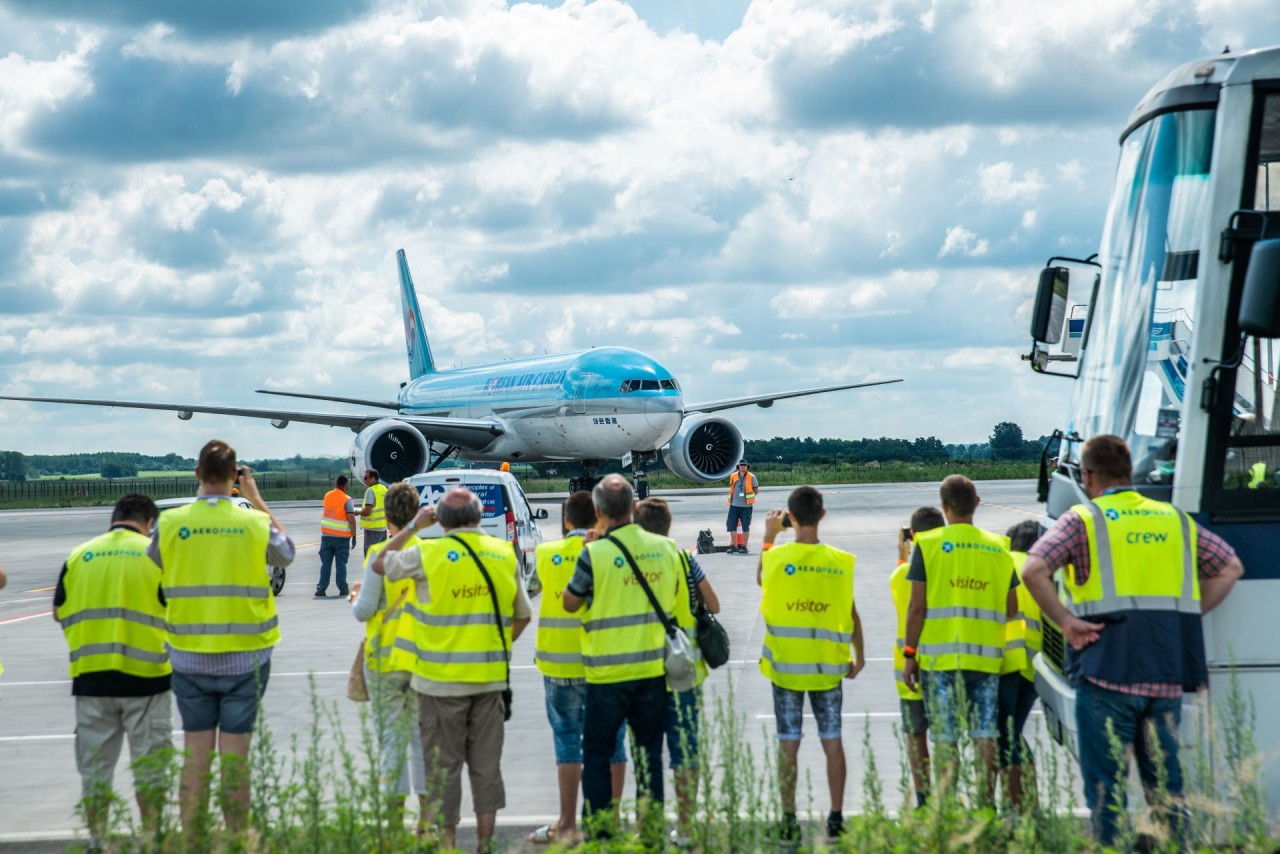
Retro vibes, up-close thrills, big jets within arm’s reach. Step behind the scenes of Budapest Ferenc Liszt International Airport (Budapest Liszt Ferenc Nemzetközi Repülőtér) and see the side of aviation you never get as a passenger. Fixed dates for our guaranteed airport tours are live—pick your slot and join us by day or after dark in this extraordinary little city within a city. Don’t miss it: get close to the hidden world of air travel at Budapest Ferenc Liszt International Airport (Budapest Liszt Ferenc Nemzetközi Repülőtér) with our guided bus tours from Aeropark.
What the Tours Cover
We run airport visits and hangar tours by day and night, taking you into areas most travelers never see. You’ll get right to the action zones: runways, aprons, navigation gear, radars, the control tower area, even the fire base—places most airport staff never access either. This is the place where even the concrete glows: on surfaces that absorb the impact of aircraft weighing hundreds of tons.
A Self-Contained Little City
Budapest’s airport functions like its own town inside the metropolis, with wells, a waterworks and treatment plant, and a heating plant. From touchdown to takeoff, a small army works to a split-second choreography so a plane can land, unload, reload, refuel, and depart again in about 30 minutes. And the biggest chunk of air traffic control doesn’t even happen in the tower—or on the airport grounds.
Runways, Aprons, Taxiways: How It All Fits
Ferihegy (Ferihegy) has two “bayonet-system” runways for arrivals and departures: one is 3009 meters (9873 feet) long, the other 3707 meters (12,162 feet). A runway is a long, straight concrete or asphalt strip where planes accelerate to reach the lift needed for takeoff, and where they decelerate after landing to exit safely. Orientation is set by prevailing winds and surrounding obstacles; length, width, load-bearing, and instrumentation are tailored to the typical aircraft and the airport’s mission.
Planes park on aprons. On the main aprons, aircraft “turn around” between flights while passengers board and disembark, fuel is loaded, and cargo is handled. Cargo aprons swap passengers for goods; technical aprons near hangars hold aircraft awaiting or just finishing maintenance. Taxiways, narrower than runways, weave a complex network linking aprons and runways to keep ground movements efficient.
How Pilots Navigate the Maze
Runways, taxiways, and aprons share a unified 27.5-inch-thick load-bearing structure, with markings, lighting, and signage guiding movements—vital in poor visibility. The airport uses about 5,500 navigational lights, many now LED for efficiency and longevity. Both runways are equipped with world-class Instrument Landing Systems (ILS) in both directions. On the pavement, giant numbers and letters mark runway headings and sides, distorted to match the 3-degree glide path. Internationally standardized markings and colors guide aircraft with decimeter precision even amid busy ground traffic. You’ll even spot the familiar octagonal red STOP sign painted on concrete—this time with an aircraft symbol reminding ground vehicles to yield to taxiing jets.
Why 13L/31R?
The runway numbers come from their magnetic heading, dropping the last digit. With parallel runways, letters L and R indicate left and right. So the second runway is 31R when approached from Monor (Monor), and the same strip is 13L when approached from Rákoshegy (Rákoshegy). Both runways demand constant upkeep: winter snow clearing, scrubbing rubber deposits from touchdown zones, renewing expansion joints, and maintaining inset and frangible-mounted lights—many calibrated regularly by aircraft or specialized ground gear.
From Grass Field to Dual Runways
Like most early airports, Ferihegy (Ferihegy) started as an oval pasture, its outline still traced today by a service road and remnants of a thorny mock orange hedge that once served as fencing. In the 1920s–30s, light, low-powered aircraft needed to land and take off straight into the wind, guided by a red-and-white windsock called the buló (buló). As planes grew heavier and more powerful, paved runways became essential. Choosing their orientation was often as simple as following the most worn grass—here, the dominant northwesterly winds set the first runway’s direction.
A 1500-meter (4921-foot) paved runway opened in 1950, then lengthened to 2500 meters and later to 3009 meters (9873 feet). Old aerial photos show plans for a crosswind runway, northeast–southwest, but as aircraft got better at handling crosswinds, it was never built.
The idea for a second runway emerged in the 1970s—not mainly for capacity (Gatwick handles tens of millions on one runway) but for resilience. Ferihegy (Ferihegy) was Hungary’s only public international airport; if a single runway closed, air travel would halt nationwide. The solution: a parallel runway matching the original heading for wind alignment and maximum efficiency. Properly spaced parallel runways can double capacity compared to crossing ones.
The Bayonet Layout
The new runway’s centerline sits 1600 meters (5250 feet) from the old one, enabling independent operations. It’s offset to the southeast in a “Z” or bayonet layout to minimize taxi distances and optimize throughput. If one runway handles arrivals and the other departures, hourly movements jump. Aircraft arriving on 31R from the southeast roll straight to Terminal 2’s apron; departing flights barely taxi before reaching runway 31L on the first runway.
The second runway is 3707 meters (12,162 feet) long and 45 meters (148 feet) wide, or 60 meters (197 feet) including two 7.5-meter (24.6-foot) paved shoulders. There’s a 23-meter (75-foot) elevation difference end to end—well within the 1% slope allowed internationally. In low visibility, top-tier lighting and ILS keep operations safe and steady. The “new” runway opened in 1983.
Runway Run: Sneakers on the Strip
Every late summer for nine years running, there’s one day when running shoes scuff the concrete of Runway 1 instead of landing gear. Around 1,100 participants from the global aviation community line up for the Runway Run, a charity race. Entry fees fund programs by Hungary’s SUHANJ! (SUHANJ!) foundation and pediatric bone marrow transplant surgeries via the UK’s Anthony Nolan charity—supported annually by Budapest Airport.
Join the Tour
Curious for more behind-the-scenes Ferihegy (Ferihegy)? Come along. Our route ventures into zones sealed off from passengers and even many airport workers: traffic and technical aprons, runways, navigational equipment, radar sites, and a host of locations that used to be off-limits. Sign up and see the airport like never before.